
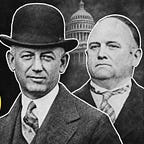

In the spring of 1927, two men had brand-new offices waiting for them in Washington, D.C. They had staff. They had furniture and electric fans. They had their names on the doors. According to one newspaper, they even had potted plants delivered by the government’s own botanical garden.
Everything a United States senator needs. Everything except permission to be one.
Frank Smith of Illinois and William Vare of Pennsylvania had both won their elections in November. Voters had picked them. The votes were counted. And the Senate looked at the results and said… not so fast.
I’m Chris, and this is Hidden Lens History.

Here’s how it’s supposed to work. You win a Senate race. Your state’s governor signs an official certificate saying that you won. Those are called your credentials, and they go to Washington. On the first day, you walk down the aisle, raise your right hand, and take the oath. Done. You’re a senator.
But there’s a line in the Constitution most people have never read. It says each house of Congress shall be, “the Judge of the Elections, Returns and Qualifications of its own Members.”
In plain English, the Senate gets the final say on who gets into the Senate. Almost always, that’s a formality. The Senate looks at the certificate, nods, and swears you in.
But in 1926, it didn’t nod.
On November 2, 1926, Illinois and Pennsylvania each elected a new senator. Both winners were Republicans, and both walked into Election Day already under a cloud because of what happened months earlier in the primaries.
Quick refresher. The primary is the election before the election. It’s how a party picks its candidate for November. And in Illinois and Pennsylvania in the 1920s, Republicans were so dominant that winning the Republican primary was most of the battle.
That made the primary the place to spend the money. And there was a gap in the rules. The Supreme Court had ruled that federal campaign-spending law couldn’t reach primaries. So the money poured in, and the only check left was the Senate’s door.
Four days after the election, the Commercial and Financial Chronicle was already warning that both men’s seats were in jeopardy. The votes had been counted, but the real fight was just beginning.
Let’s start with Frank Smith. Smith’s day job was chairman of the Illinois Commerce Commission, the state agency that regulated utilities. The electric companies. The gas companies. The streetcar lines. Among other things, it had a say in what those companies could charge you.
The biggest utility man in the Midwest was Samuel Insull, who had built an empire supplying power and transit around Chicago. During Smith’s primary campaign, Insull contributed $125,000 to Smith’s campaign fund. That’s more than $2 million in today’s money.
Let’s put it this way. It’s basically the referee accepting a very large check from one of the teams while they’re refereeing.
Smith didn’t see the problem. In December, the Eugene Guard reported his defense. Businesses that benefited from protective tariffs, the taxes on imported goods that shield American companies from foreign competition, gave money to presidential campaigns all the time. So why was utility money any different?
His critics had a simple answer: because he was the one regulating the utilities.
Then the story took a strange turn. The man Smith had beaten in that primary was the sitting senator from Illinois, William McKinley. No relation to the president. In December 1926, with three months left in his term, McKinley died. And Illinois Governor Len Small appointed Frank Smith to fill those last few months.
So now Smith had two tickets in: an appointment to finish McKinley’s term, and his own election to the full six years after that. In January 1927, he showed up with the first one. The Senate refused to seat him until a committee looked into his campaign.
Meanwhile, in Pennsylvania, William Vare had a different kind of power. He was the boss of Philadelphia’s Republican political machine.
A political machine was an organization that ran on favors. City jobs, city contracts, help with a problem at city hall. In return: votes. Lots of reliable votes. Vare and his brothers had made a fortune on city contracts, things like street cleaning and garbage collection, and built a political operation right alongside it.
In the 1926 Republican primary, Vare beat the sitting senator, George Wharton Pepper, and the sitting governor, Gifford Pinchot. Vare’s side spent about $785,000, something like $14 million today.
Listen on Apple or Spotify, or go watch the full episode on YouTube
And here’s the thing. That wasn’t even the biggest pile. The team backing Pepper spent around $1.8 million.
In November, Vare won the general election too. His Democratic opponent, William B. Wilson, a former U.S. Secretary of Labor, refused to accept it. He accused Vare’s side of padding the voter rolls, intimidating voters, and counting phantom voters who were either dead or imaginary. At that point, those were accusations. They still had to be proven.
Even Vare’s paperwork became a fight. Remember the credentials, the governor’s certificate? Pennsylvania’s governor was still Gifford Pinchot, one of the men Vare had just beaten. Pinchot sent a certificate saying Vare, “appears to have been chosen.” And then he added that the nomination had been, “partly bought and partly stolen.”
Not exactly a ringing endorsement.
Less than two weeks later, Pinchot’s term ended, and the new governor sent Washington a perfectly ordinary certificate. So the Senate now had a winner, an angry loser, and two very different letters from the same state.
And here’s where the story gets its wonderfully bureaucratic middle chapter.
Their terms officially began in March 1927, but back then a new Congress didn’t actually sit down to work until December. So for most of the year, Smith and Vare were in limbo. Not accepted, not rejected, just waiting.
And while they waited, Washington set them up like senators anyway. In April 1927, reporter Rodney Dutcher toured their offices. Staff, furniture, electric fans. Those government plants we talked about. Letters from constituents being answered. The whole machinery of a Senate office, humming along around two men who might never actually be senators.
By December, they’d even been assigned temporary desks in the Senate chamber. The Oregon Statesman reported exactly where. Smith’s was at the end of the back row, near a rear exit. Vare’s was at the end of the next row, also near an exit.
The seating chart practically wrote its own punchline.

On December 5, 1927, the new Congress finally met. Neither man was allowed to take the oath. Their supporters said the voters had spoken, and the Senate had no business overruling them. Their opponents said the Senate had a duty to make sure those votes were honestly won.
Smith’s case came to a final vote on January 19, 1928. Sixty-one to twenty-three. The Senate ruled he was not entitled to his seat.
Governor Small did not take it quietly. The next day, the Capital Journal ran it across the front page: “ILLINOIS TO INSIST UPON SMITH.” Small called the decision an attack on the people’s right to choose their own senator.
Then he tried something bold. Smith resigned. And the governor turned right around and appointed him again. This time, Smith didn’t even try to claim the seat. That spring, he ran in the Republican primary one more time.
And lost.
Vare’s fight dragged on almost two more years.
In early 1929, the committee digging into Pennsylvania’s election delivered a brutal report. It called the fraud in Philadelphia’s vote counting appalling. By its estimate, a Philadelphia voter had about a one-in-eight chance of having his ballot counted correctly.
But here’s the twist. A different Senate committee went through the numbers and concluded that even after you threw out the bad votes, Vare still had more legal votes than Wilson.
So Vare probably did win. The question was whether the way he got there, the money and the fraud swirling around his machine, should keep him out anyway.
By then, Vare had suffered a stroke that left him partly paralyzed. In December 1929, he came to the Senate to defend himself with his doctor at his side. He argued the money had been needed to build a statewide campaign, and he waved off the election problems as clerical errors.
On December 6, 1929, the Senate voted. Fifty-eight to twenty-two. Vare was out. The Capital Journal’s headline was blunt: “VARE LOSES SENATE SEAT.” More than three years after winning his election, William Vare had never taken the oath.

His statement afterward: “I feel that a great injustice has been done my state and myself.”
And Wilson, the man who challenged him? The Senate voted that he hadn’t been elected either. So the governor of Pennsylvania appointed someone else entirely. Joseph Grundy, a wealthy manufacturer, famous for lobbying for high tariffs and raising campaign money from the businesses that profited from them.
Which is to say, the exact kind of money Frank Smith had held up as perfectly normal.
So that’s how it ended. Two states held elections. Voters picked their winners. And the Senate used a power most of us forget it has and said no.
For Smith and Vare, the government could supply an office, a staff, a desk near the exit, and even something green for the windowsills.
But it just wouldn’t let them become actual senators.
Thanks for listening - Chris
Think you can spot real headlines and stories? Play our daily game and read some wild stories from the newspapers at MadeThePapers.com.


