

It’s 1936, and Toronto newspapers are counting babies.
A contest is underway to see which mother can have the most children in ten years. The prize is a fortune. And the man offering it has been dead for ten years.
His will said his money would go to the Toronto mother who had the most babies in the decade after he died. Now time is almost up, and someone might actually win.
If the courts let it happen.
I’m Chris and this is Hidden Lens History. Every day I open the newspaper from exactly 100 years ago and find something worth following.

His name was Charles Vance Millar. He died on Halloween, 1926. He was a rich Toronto lawyer with no wife and no children.
His will opened with a warning. He called it “uncommon and capricious.” In other words: strange, and on purpose.
He had no family to provide for. He said the money he left behind proved how foolish it was to collect more than you need.
Then he started giving it away, in ways designed to make people squirm.
He left shares in a brewery to Protestant ministers who opposed drinking. He left shares in a horse-racing club to men who opposed gambling. He left his vacation house in Jamaica to three lawyers who, according to the papers, couldn’t stand each other.
Every gift came with a catch.


Then came the rest of his money. It was to be invested for ten years. After that, it would go to the Toronto mother with the most officially recorded births. If there was a tie, the winners would split it.
The newspapers got the joke. But they also saw a problem.
Within weeks, the Toronto Star reported that someone might try to throw out the baby contest as harmful to the public.
Should a man be allowed to use his money to push women into a baby race? What would that do to mothers and their children?

That question would keep coming back. But the will held up, and the years went by.
And by the end of those years, Canada was in the Great Depression.
In 1935, a newspaper series called the will a half-million-dollar joke. It described mothers with big families, several of them living on government help, waiting to see if Millar’s money would be theirs.

The next summer, the St. Louis Post-Dispatch covered the contest almost like a horse race. It tallied births. It listed babies on the way. It wondered what twins or triplets might do to the standings.
It called it “Canada’s Startling Maternity Contest.” Another paper called the children “Golden Babies.”
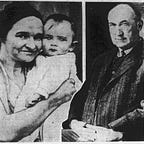
But the photos told a different story. These were families just trying to get by.
One of the front-runners was Alice Timleck, who went by Lucy. She started working on a farm at age six and had only six months of school. She later learned to read and write in night classes.
Now she had a big family, and reporters were asking what she’d do with a fortune.
Her answer was simple. A decent house. Help with the housework, so she could take better care of her kids. Schooling. Clothes.
She also wanted to share the prize with the other mothers, so everyone would get something. Some families agreed. Others didn’t.

Another top contender was Kathleen Nagle. Her husband had been out of work for years. A reporter visited at dinnertime: meat patties, potatoes, corn, and bread, all paid for with welfare vouchers. The kids ate every bite, then helped clean up.
Her husband, John, said he’d like a farm. Somewhere quiet. Good for the kids.
Kathleen was open to sharing the prize too. But she worried about a surprise. What if some mother nobody knew about suddenly had quintuplets?
She called that a “dark horse.”


The deadline was October 31st, 1936. Once it passed, the counting stopped and the fighting started.
Millar’s relatives went to court to cancel the contest. They argued it pushed women into having baby after baby, hurting their health and their families. The race was over, but the money could still vanish.

And there was another question. Which babies counted?
Pauline Mae Clarke had ten children. But five were born after she split from her husband. The courts decided babies born outside marriage didn’t count.
Lillie Kenny said she’d had more babies than some of the leaders. But questions came up about how some births were recorded, and about babies who were stillborn.
It was a harsh rule: the number of babies a woman had might not be the number the court would accept.
Outside the courthouse, photographers waited for the mothers. Some of the women slipped in through a side door. For once, the paper said, the cameramen didn’t get their shot.

The case went all the way to Canada’s Supreme Court. In December 1937, the court let the contest stand. The judges said there wasn’t enough proof that it harmed the public.
The money could go to the mothers. Now the court just had to decide who they were.
In March 1938, the answer ran across the front page: “Four Mothers Divide Millar’s $500,000.”
Annie Smith. Kathleen Nagle. Lucy Timleck. Isabel MacLean.
Each had nine children that counted. They would split the fortune four ways. Clarke and Kenny didn’t share in the prize, but each later got a settlement of twelve thousand five hundred dollars.

And yes, the winners got real cheques. Reports said each mother’s first payment was about a hundred thousand dollars, with more to come.
By then, Millar had been dead for more than eleven years.
The will the papers had laughed at was now real money for real families. Some of it even had to go back to the city, to repay the welfare that had kept them going while they waited.
Long before she knew she’d win, Alice Timleck had said what she wanted: a home, help raising her kids, an education for them, and decent clothes.
“That’s all we need or ask for,” she said.
See you next time - Chris
Go play our new game - Made the Papers - and see if you can spot the real story from an old newspaper. New theme every day.
Sources: The Toronto Daily Star (Dec. 7, 1926), The Evening Telegram (Toronto; Nov. 5, 1926; Oct. 29 and Nov. 6, 1936), Council Bluffs Nonpareil (Nov. 5, 1926), Lebanon Daily News (Nov. 5, 1926), The Belleville Daily Advocate (Nov. 6, 1935), St. Louis Post-Dispatch (June 15, 1936), Des Moines Tribune (Aug. 25, 1936), The Buffalo Times (Oct. 26, 1936), The Star Weekly (Toronto; March 19, 1938).


