


In October 1926, a London lawyer walked into the post office and paid to send a message… to Mars.
And that wasn’t even the strangest part. The post office said yes. And this wasn’t the first time he was communicating with Mars. He even had proof.
I’m Chris and this is Hidden Lens History. I open 100 year old newspapers, and find the stories worth sharing.

So who was this man?
His name was Hugh Mansfield Robinson. The papers called him “Doctor,” but he was actually a lawyer, and a former town official in London. In his village, people knew him as a kind man who loved animals and kept bees. He’d also invented a device to make walking easier, using elastic bands attached to his ankles.
And he believed he was in contact with a woman on Mars.
He said he could talk to her with his mind. Her name was Oomaruru, and she’d told him all about life up on Mars. Martians drank tea, he said. They smoked tobacco. They drove cars that can almost fly.
But Robinson didn’t just want to talk to Mars. He wanted to prove it to everyone else.
Over the next few years, he tried three separate times. First with a psychic. Then with the post office. And finally, with a scientist and a newspaper reporter in the room.
The first attempt came in March 1926, and it didn’t involve any technology at all.
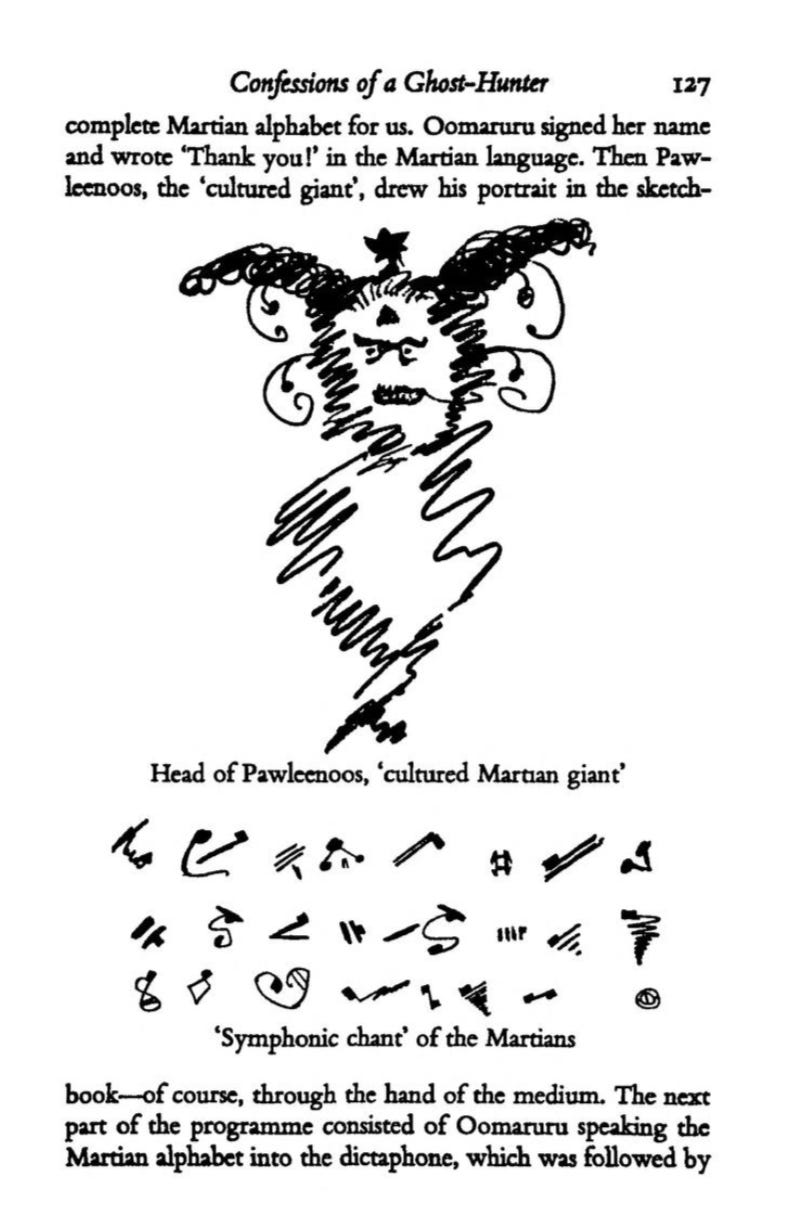
Robinson invited Harry Price to come and listen. Price was a famous investigator of ghosts and psychics, and Robinson wanted him to record Martian voices. Those voices would come through a medium, a woman named Mrs. St. John James, who would act as a kind of human telephone line to Mars.
Robinson even sent over a program for the evening: poetry, messages, and a love song.
As Price described it years later, they sat around a table with the lights on and the recording machines nearby. Mrs. James began speaking in a strange language and scribbling in a sketchbook. [sound effects in background of a woman speaking gibberish?] Robinson said the marks were a Martian alphabet. A Martian giant supposedly drew his own portrait, using her hand. And a Martian princess sang a love song.
Price said it sounded like a rooster crowing.
He came away with a recording, but no proof that any of it came from Mars. So Robinson decided to try something people couldn’t argue with.
He’d use radio.

In the 1920s, radio felt like magic. Just a few years earlier, it had been a hobby. Now it was sending messages across entire oceans, in an instant, through thin air. And if it could reach across the Atlantic, people wondered, why not space?
This wasn’t only a question for fringe believers. Serious newspapers ran long articles about it. The radio pioneer Marconi reported picking up strange signals he couldn’t explain. Science writers proposed ways to call the planet.
None of that made Robinson right. But it meant that when he tried, people listened.
That brings us to the second attempt, the one from the beginning of our story.
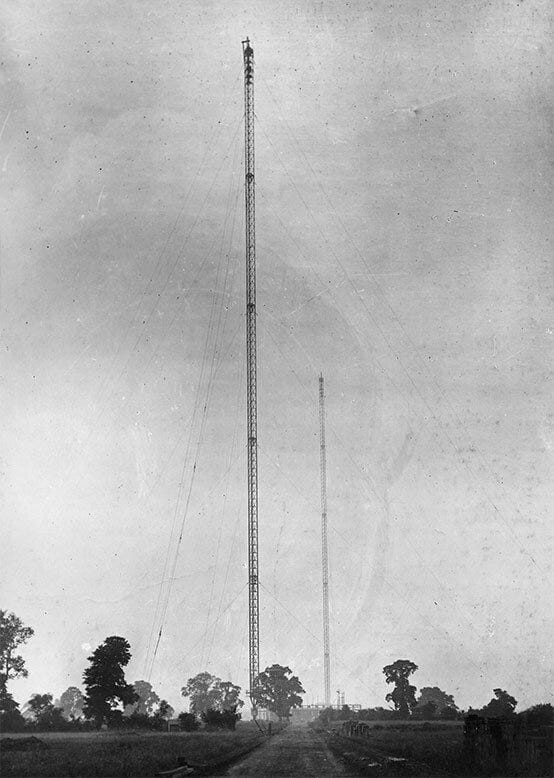
In Britain back then, the post office didn’t just deliver letters. It also ran the telegraph and radio services. And in 1926, it had just opened Rugby Radio Station, the most powerful radio transmitter in the world.
So in October, Robinson went to the post office and asked them to send a message to Mars.
They agreed, at the regular price of one shilling and sixpence per word. An official even suggested sending it twice, since it was so important. Robinson paid for both.
The message was three words, set to go out at 11:55 on the night of October 27th:
“Opesti. Nipitia. Secomba.”
When reporters asked what it meant, Robinson said, “Oomaruru surely understands.”
No answer came back. But Robinson had an explanation. Oomaruru told him the Martians had gone quiet on purpose, because a message in English would never convince the scientists.
So two years later, he tried a third time. And this time, he made sure there’d be witnesses.

It’s October 1928. A reporter from the Daily Mirror is sitting in a lab outside London, owned by a scientist named Professor A. M. Low. Robinson is there too. Three men around a radio set, waiting for Mars.
The plan was bigger this time. Rugby would send the message out. And post office engineers at another station would listen for a reply, so it wouldn’t just be Robinson’s word.
The message was simple: “Love to Mars. God is Love.”
Robinson believed this was one of the most important moments in history. He even wondered whether a recent windstorm had been a signal from Mars.
Then he opened a bottle of champagne, and the three men drank to the Martians’ health.

By four in the morning, Robinson announced that messages had come in. They just needed decoding.
But remember those engineers, the ones whose whole job was to listen for a reply? They didn’t hear anything.
The next day, Robinson explained what went wrong. The wavelength was off he said. The Martians had waited for hours, he said, and were annoyed that the signal never reached them.
His wife was also annoyed. She was turning reporters away from the front door and calling the whole thing nonsense.

Three attempts, and no proof. You might think that would be the end of it.
But it wasn’t. Five years later, in 1933, Robinson was still talking to Mars, and his story had grown even stranger.
He now said Oomaruru was actually Cleopatra. Yeah, the queen of ancient Egypt. She was living on Mars now, he said, married to a farmer.
One newspaper noticed something odd. Robinson described Martians with advanced airplanes and trains, yet they’d never heard of a record player until he explained how to build one.
His story kept getting bigger. The proof never quite showed up.
Which brings us back to the question from the beginning. Why did the post office say yes?
The answer turned up in a post office memo about the 1928 attempt. As writer Marc Hartzman reported it, they helped “mainly in order to obtain free publicity for Rugby.”
Every newspaper story about the man calling Mars was also free advertising for their new radio station, and what it charged. And officials were careful to say that they were simply selling a service. They were not taking part in a science experiment, or promising they could actually talk to Mars.
Mars never answered with proof, and Robinson kept explaining the silence. The post office kept collecting its fees and gaining customers. And the rest of us? We’re still waiting on that word from Mars.
See you next time - Chris
Go watch this episode on YouTube
Think you can spot real ones from fake ones? Go play our daily game at www.madethepapers.com
Or try your hand at being a 1920’s bootlegger and play Bootleggers Trail
RESEARCH & FURTHER READING
Marc Hartzman, Weird Historian: “Earth to Mars in the 1920s: The Strange Case of the Man Who Tried to Contact Martians via Radio.” The article includes reproductions of post office documents and historical images.
https://www.weirdhistorian.com/the-strange-case-of-the-man-who-tried-to-contact-martians-via-radio/
Harry Price, Confessions of a Ghost-Hunter, pp. 124–128.
Newspaper reporting featured in the episode includes the Morning Register (October 29, 1926), the Daily Mirror and Abilene Daily Reporter (October 24, 1928), and the Marysville Journal-Tribune (April 1, 1933).


