
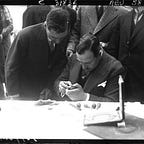

A chambermaid picks up an apple and takes a bite. Her teeth hit something hard.
Inside the apple is a pink diamond. Newspapers valued it at more than two million dollars. And just two months earlier, that same diamond had been stolen from a French castle.
The men who took it had pulled off an extraordinary heist. But they’d chosen a jewel that might be too famous to sell to anyone.
Either way, why was the most famous diamond in France inside an apple?
I’m Chris, and this is Hidden Lens History. Every day I open the newspapers from exactly 100 years ago and find a story worth following.
***
Let’s go back to the night of the heist. It’s just after midnight, October 12th, 1926. North of Paris, Léon Kaufer and Émile Souter approach the château at Chantilly.
Between them and its treasures, stand a moat and castle walls.
The bridge has been drawn up. So the men cut a long sapling, attach a rope, and reach out until they hook the bridge. They pull it down towards them and across the moat.
At the tower, they need ladders. Two of them. They tie them together, and lean them up against the wall. One ladder measures seventeen feet. The other is slightly shorter. Souter climbs. Kaufer stays below. But even joined together, the ladders don’t quite reach. So Kaufer bends down, grips the bottom, and lifts with Souter still on it.
Souter is still about three feet below the top. He grabs the masonry and vaults himself up. He forces his way inside, breaks the display glass and sweeps the beam of his electric torch across the room.
The Liverpool Echo later describes what the light revealed: “masses of jewels flashing from their velvet beds.”

Diamond-studded daggers. Jeweled bracelets. Watches. Even a cross Napoleon had given to a general. These objects have passed through people’s hands for generations. The castle has become a museum that preserves them.
Now Souter empties the display cases. The loot comes down the ladder in several trips. The men take the pink diamond, too. Then they restore the bridge to its original position and return to Paris by train.
While people slept in the opposite wing of the chateau, the two men got away.
***
The very next day, October 13th, 1926, the theft reaches American newspapers. Even the Daily Missoulian in Montana ran it on the front page. It puts the haul at a hundred million francs.
The report says the objects’ are “relics of a by-gone age” and their values are “beyond calculation.”

The Associated Press says France hasn’t been this stirred by a crime since the Mona Lisa disappeared from the Louvre fifteen years earlier.
That painting vanished in 1911. Its thief kept it for more than two years. When he finally approached an Italian art dealer, the dealer alerted authorities. A painting everyone recognized had become something its thief couldn’t sell safely.
Now another famous treasure has disappeared. The pink diamond’s name—the Grand Condé—travels with the news. And jewelers warn that it could become a “white elephant.” A treasure they might just be stuck with.

Picture Kaufer and Souter back in Paris. They’ve got the diamond. Now they need someone who recognizes its value without reporting where it came from.
So what can these men actually sell?
Well the Grand Condé isn’t the only thing they took. Some of the other loot found buyers. Just two months later, the San Francisco Examiner reported that a diamond even larger than the Grand Condé reached an American through stolen goods dealer.

Other pieces got stripped. The Morning Pioneer describes the thieves pulling smaller stones from the jewelry, throwing the settings into the Seine, and selling the loose gems to unsuspecting jewelers.
One of those jewelers, accused later of being not-so-unsuspecting, was Madame Schill, a Paris jeweler who bought many of the stolen pieces. One account even mentioned her explicit refusal to buy the Grand Condé.
But for the thieves themselves, they made about twelve hundred dollars. But the pink diamond stayed with Kaufer.
***
By December, Kaufer has a room at the Métropole Hotel in Paris. And he’s keeping the diamond in an apple.

The Stratford Evening Post describes what happens next. Kaufer stays away all night. His landlady grows suspicious so searched his bag while he was out. She takes out the apple and sets it on the mantelpiece. Later, the chambermaid picks it up while dusting the room. She’s a little hungry so takes a bite, and her teeth strike the diamond. They immediately alert authorities.
When Kaufer returns, a detective is waiting. He confesses. Souter is arrested too.
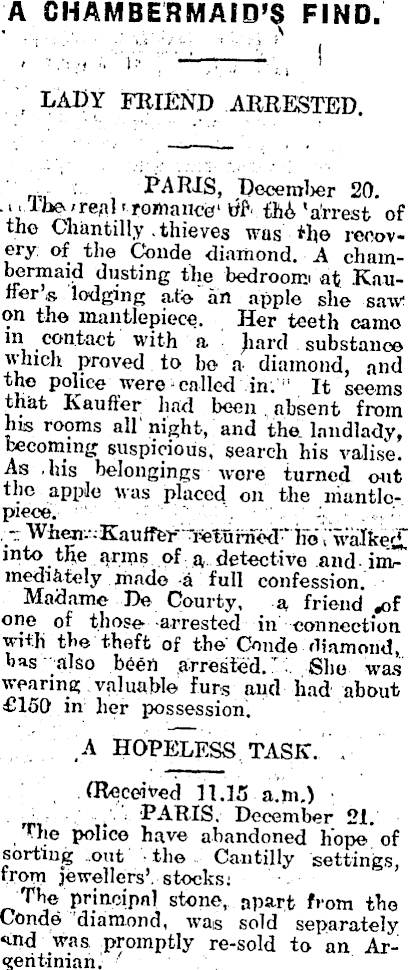
A French newspaper reports Kaufer said to authorities, “I could not sell this diamond; it risked me getting arrested.” He claims he’d intended to return it to Chantilly. The treasure he’d carried out of the castle had become something he wanted to give back.
***
Six months later, three people face trial: Kaufer, Souter, and Madame Schill—the jeweler involved in buying those stolen pieces.
And the trial? It’s wild.

The police reconstruct the raid, and According to the Liverpool Echo, the defendants’ lawyers request that it be filmed. The men played themselves. A film producer is hired and they film the whole thing.
The jurors watched it privately. The ladders, the tower, the men accused of breaking into it. The Echo’s correspondent could barely believe what he was seeing.
The men blamed Kaufer’s wife for instigating the theft. One newspaper reported the accusation led to quite a “heated scene in the court.”
At this point it seems like the two men turned stealing the famous diamond into fame for themselves. But the sentences eventually came down. Ten years for Kaufer. Eight for Souter. Madame Schill receives a five-year suspended sentence.
The pink diamond returned to Chantilly.
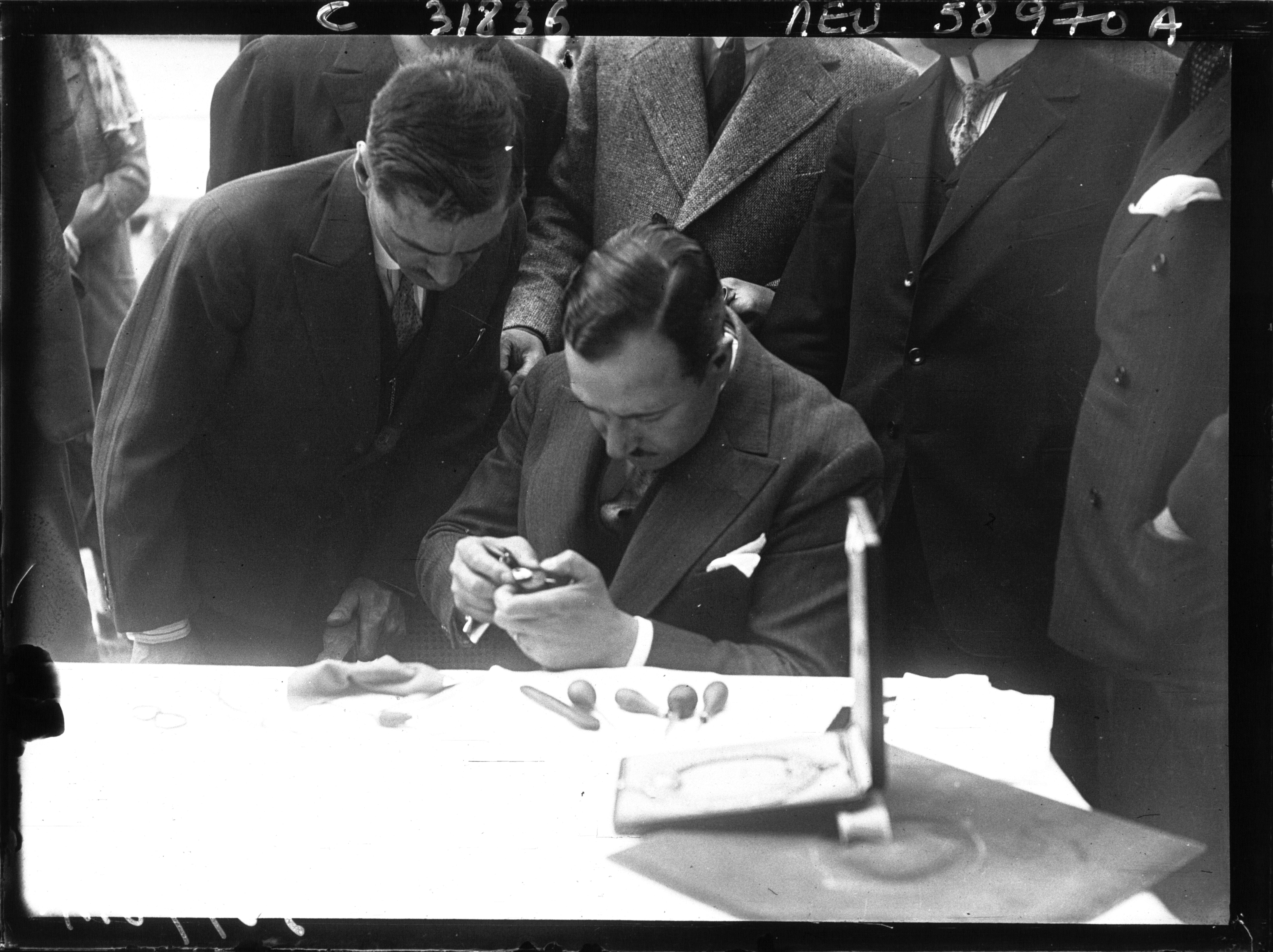
And it’s still there.
A century after the theft, Chantilly has organized an exhibition devoted to that same diamond. It opens in just a few days, October 17th, 2026 and runs through January.
The diamond never became worthless. A century later, people are still paying to see it. But Kaufer couldn’t turn that value into money. What he and Souter had created was an incredible story. Newspapers carried it around the world for months. A film recreated their extraordinary climb. And the thieves became the leading men.
If someone swiped that diamond today, the same thing might happen. It’d be tough to sell. But this time maybe they’d cash in on a documentary.
See you next time - Chris
If you like strange headlines, test your skills with our game www.madethepapers.com every day to see which history is stranger than fiction!
Sources
The Daily Missoulian — October 13, 1926. Via Newspapers.com.
San Angelo Evening Standard — October 13, 1926. Via Newspapers.com.
Morning Pioneer — December 21, 1926. Via Newspapers.com.
The San Francisco Examiner — December 22, 1926. Via Newspapers.com.
Stratford Evening Post — December 22, 1926. Via Papers Past, National Library of New Zealand.
Liverpool Echo — June 23, 1927. Via Newspapers.com.
Darmstädter Tagblatt — July 1, 1927. Via University and State Library Darmstadt.
Otago Witness — July 5, 1927. Via Papers Past, National Library of New Zealand.
Additional references
Lauriane Brémond, “Le vol du ‘Grand Condé’”, GEMMES, Spring 2025. Includes Kaufer’s reported statement reproduced from Le Petit Journal.
Marie-Hélène Quellier-Caranjeot, Étude gemmologique de deux diamants historiques : Le Grand Condé et Le Penthièvre, University of Nantes, 2005.
Photograph
M. Serror setting the Grand Condé diamond at Chantilly — June 18, 1928. Agence Meurisse / Bibliothèque nationale de France, Gallica. Public domain.


