


There’s a scene in Seinfeld where Kramer makes a ridiculous promise to a sick child. He tells the boy that Yankees outfielder Paul O’Neill will hit two home runs for him.
O’NEILL: “What?”
KRAMER: “You know, a couple of dingers.”
O’Neill finds out, and he’s horrified.
O’NEILL: “That’s ridiculous I’m not a home run hitter.”
KRAMER: “Well, Babe Ruth did it.”
O’NEILL: “He did not.”
KRAMER: “You’re saying that Babe Ruth was a liar?”
O’NEILL: “I’m not calling him a liar, but he wasn’t stupid enough to promise two.”
It’s a great joke. But the weird thing is, Kramer is referencing a real story. And one hundred years ago today is the day it happened.
I’m Chris, and this is Hidden Lens History. Every day I open the newspapers from exactly 100 years ago, find something worth sharing, and follow the story wherever it goes.
On October 6th, 1926, Babe Ruth and the New York Yankees were in St. Louis for Game Four of the World Series.
And in some cities, if you picked up a newspaper that afternoon, you already knew what happened in the game. The Daily Messenger in Canandaigua, New York managed to get the news onto its front page that same day.

The headline read: “BABE RUTH HITS THREE HOMERS.” He was the first ever to hit three home runs in one World Series game. Below the headline was a complete box score: Yankees 10, Cardinals 5.
But there was another story unfolding hundreds of miles away. That one would eventually become almost more famous than the game itself.
It was about an 11-year-old boy named Johnny Sylvester. Johnny was seriously ill. And he was resting at his family’s home in Essex Fells, New Jersey.

At the time, it was unclear exactly what was wrong with Johnny. Every article that I found glosses over that part of the story. They even disagree about just how close to death he was. One story said doctors thought he might not survive the night. Another, published the next morning, claimed they had only given him 30 minutes to live. His own great-nephew claimed in a 2014 documentary that he suffered from osteomyelitis—the deterioration and infection of the bone.
Either way, at the time doctors and people around Johnny knew it was serious.
Johnny was a huge baseball fan. He was hoping to see some of the World Series games in New York before his illness made that impossible. And, he was also hoping that he could get an autographed baseball, preferably from Babe Ruth.
According to one paper, a friend of the family contacted someone in St. Louis and told him about Johnny. Eventually, two baseballs made their way back to New Jersey. One was signed by members of the Cardinals. The other was signed by the Yankees. But Babe Ruth didn’t just sign his name. He wrote Johnny a special message.

Ruth’s note said, “I’ll knock a homer for you in Wednesday’s game.”
The actual baseball he wrote it on has survived. It was displayed at the Babe Ruth Museum before eventually being sold by the Sylvester family.
Babe Ruth was Babe Ruth. But nobody can just decide to hit a home run. That’s why it got a laugh in Seinfeld. But Ruth had apparently decided he was going to try.
One newspaper published two days later painted the scene: Ruth waiting in the dugout at Sportsman’s Park, hearing about Johnny, picking up a baseball and writing the promise right before going to bat.
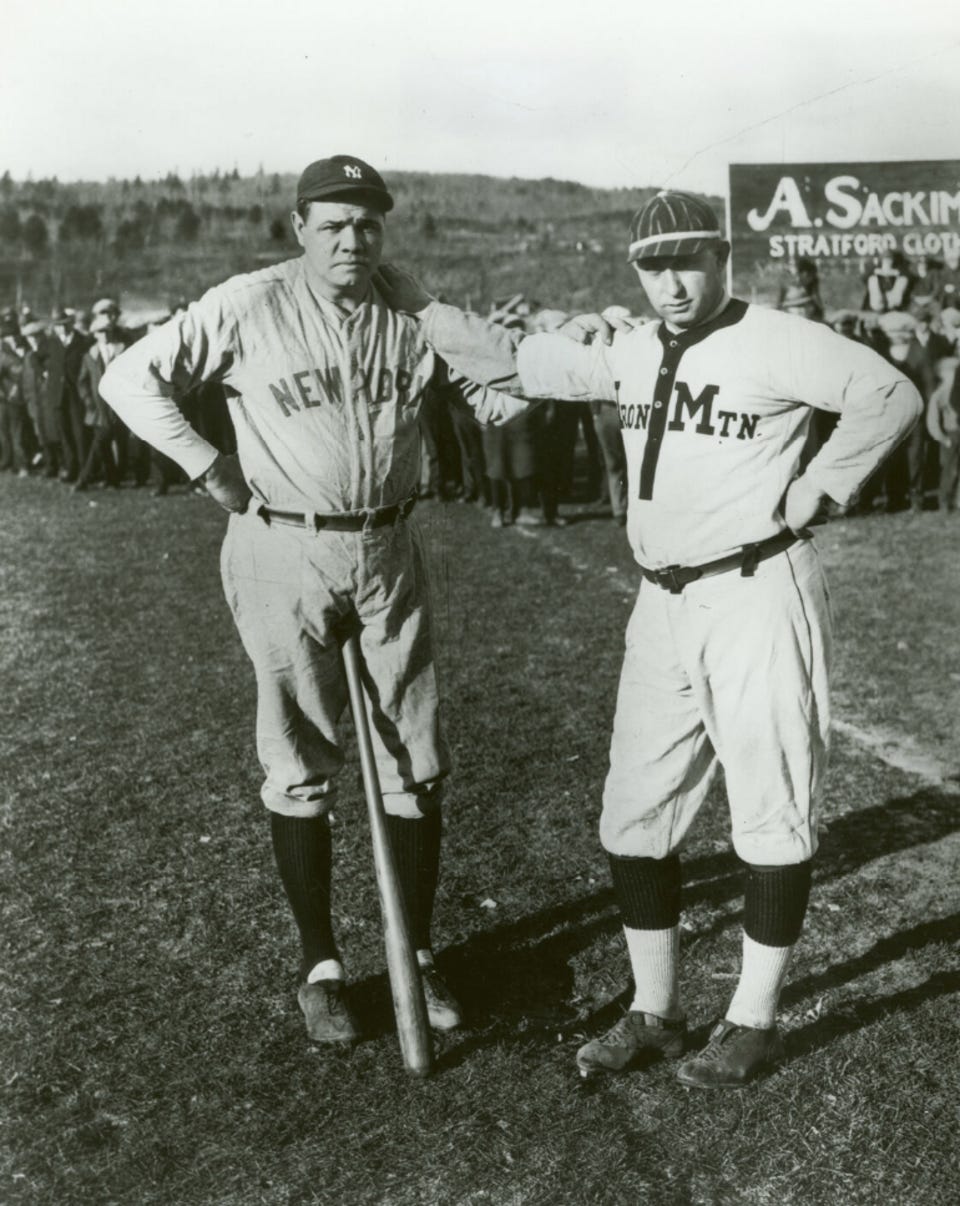
In the first inning, he came to the plate against St. Louis pitcher Flint Rhem. Ruth hit one over the right-field wall. Promise fulfilled.
In the third inning, Ruth came up again. Another home run. Then, in the sixth inning, he did it again. Three home runs in one World Series game. Nobody had ever done that before. Yankees win 10 to 5.
But here’s where the newspaper story gets really good. The next morning, October 7, a wire story from Essex Fells reported that Johnny had received both baseballs by air mail. And according to that story, when his father gave him the balls, Johnny only had one question: “Did Babe knock a homer?”
His father showed him the newspaper. Across the top of the page: “Babe Ruth hits three homers.”
The best part? Babe Ruth didn’t just promise a sick child a home run, hit three, and that’s the end. The paper said Johnny went to sleep holding a baseball in each hand. And when he woke up, his nurse took his temperature. It had fallen two degrees.
He was getting better.
The story kept growing. The October 7th Journal Gazette retold the whole thing under the headline “TWO BASEBALLS BRING JOHNNY BACK TO HEALTH.”

It was an irresistible story. And it was a lot cleaner than reality.
Johnny did survive. In fact, he lived another 63 years. But he didn’t suddenly leap out of bed because Babe Ruth hit three home runs. His recovery took much longer. And Babe Ruth didn’t stand beside Johnny’s bed before the game and promise him a home run like the movies show you. That part of the legend is made up. He couldn’t have. Ruth was in St. Louis and Johnny was in New Jersey. The promise came on that baseball.
Ruth did eventually visit Johnny but it was after the World Series.

When Ruth finally did show up, the newspapers were waiting. They printed photos of him at Johnny’s bedside with headlines like, “Bambino Goes To See Johnny Sylvester At His Home In Jersey.”
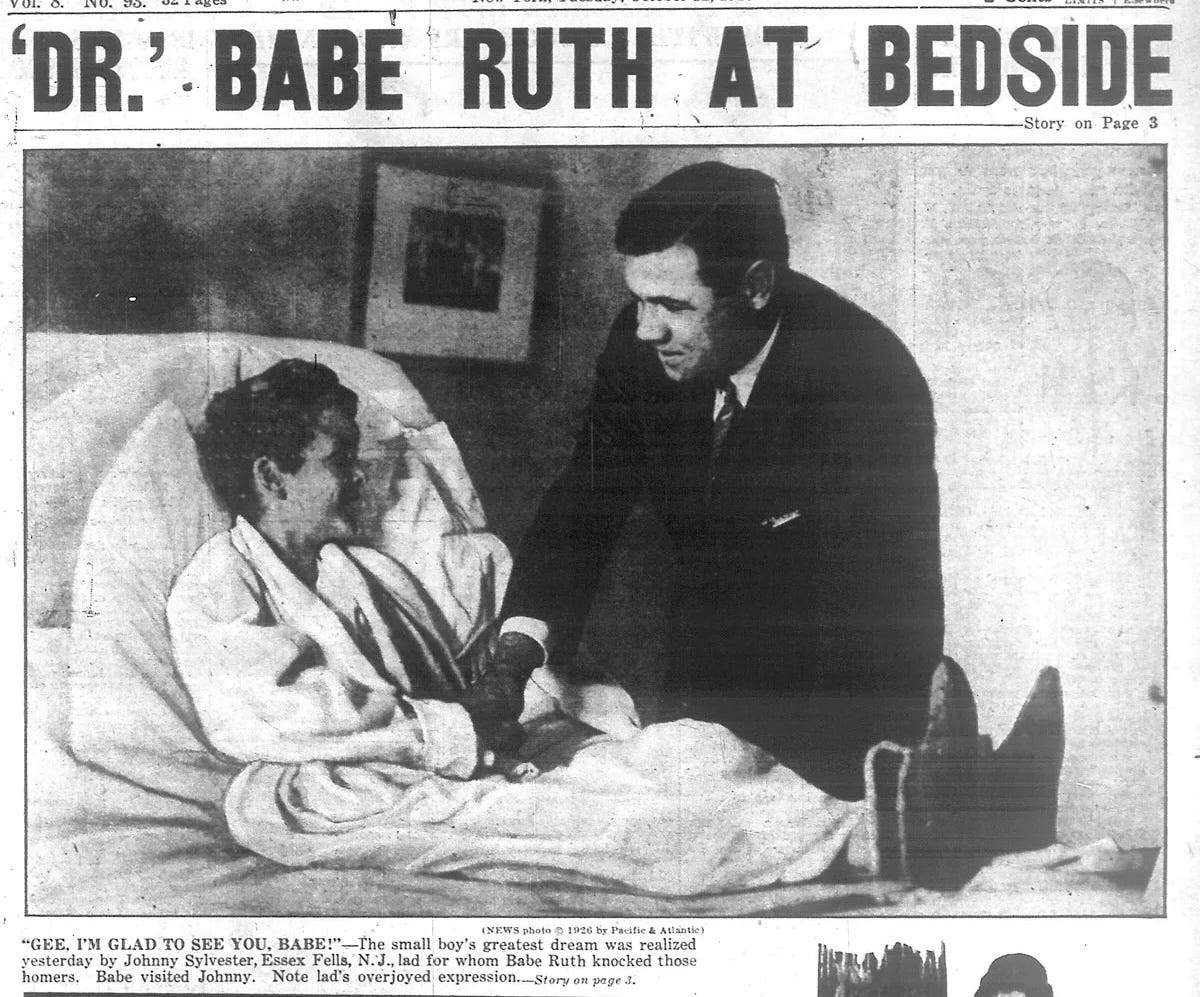
Johnny was sitting up in bed. The two autographed baseballs were beside him. He was staring at Ruth. He went speechless, and then finally managed: “Gosh!” Ruth shook his hand. Johnny apparently tried to say more but couldn’t.
After Ruth left, Johnny finally found his words, telling his mother that if Ruth were still here, he’d ask him for “a pile of things.”
Which is funny, because America was already sending him a pile of things. Two days later, tennis champion Bill Tilden sent Johnny an autographed racket. A football from Red Grange also arrived.

The paper joked that if Johnny didn’t recover soon, it wouldn’t be for lack of help from “sportsdom in general.” By then, Johnny Sylvester wasn’t just a sick kid in New Jersey anymore. He had become a national treasure.
After the actual story, Hollywood got hold of it. In 1942, the film The Pride of the Yankees borrowed the idea for Lou Gehrig.

In that movie, Gehrig promises a sick boy two home runs, with Babe Ruth playing himself. Then, in 1948, The Babe Ruth Story recreated the original episode, but changed it so Ruth visits the boy and makes his promise at the bedside.

It’s a much better movie scene. It’s just not what happened.
Eventually, in 1995, the story reached Seinfeld. Kramer needs a baseball card back from a sick kid named Bobby. So he does what any reasonable person would and promises the kid that Paul O’Neill will hit two home runs.
O’NEILL: “That’s ridiculous.”
The kid even looks like Johnny.
KRAMER: “Maybe I did overextend myself.”
When people from the Babe Ruth Museum tracked him down decades later, Johnny was able to show them the ball. There, still written across it, was Ruth’s promise: “I’ll knock a homer for you in Wednesday’s game.”
Johnny Sylvester kept in touch with Babe Ruth, and eventually grew up. He went to college, served in the Navy during World War II, and had a family and career. He lived to the age of 74, and died in 1990, just five years short of that episode of Seinfeld airing.
But he had already lived long enough to watch the story become much bigger than him. And while the Hollywood versions were good, the best version might’ve been the original. Because one hundred years ago today, Babe Ruth promised a sick kid one home run, and hit three.
See you tomorrow — Chris
Like strange headlines? Go play our new game at www.madethepapers.com and test your skills and read some wild stories.
Sources
Seinfeld, “The Wink” — Season 7, Episode 4, first aired October 12, 1995.
The Daily Messenger — October 6, 1926
Daily Notes — October 7, 1926
Journal Gazette and Times-Courier — October 7, 1926
World-News — October 8, 1926
The Tribune — October 12, 1926
Daily News — October 12, 1926
Daily News — October 14, 1926
La Crosse Tribune — September 9, 1942
Taylorville Daily Breeze-Courier — December 24, 1948Sports Collectors Daily — coverage of the surviving Johnny Sylvester baseball bearing Ruth’s handwritten promise.
2014 documentary/interview with Johnny Sylvester’s great-nephew — cited for the family account that Johnny suffered from osteomyelitis.


