
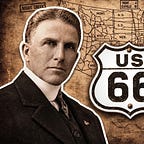

One hundred years ago today, America’s most famous highway officially got its number. Route 66. Chicago to Los Angeles.
But one of the men behind that road never wanted it to be 66. His name was Cyrus Avery, and he spent the first months of 1926 fighting for a different number. He’d already had the signs made. He believed the decision was final. Then officials in Washington told him it was changing.
The number he was fighting to keep? 60.
Today, how Route 60 became Route 66. It’s a story with an angry governor, a stack of letters, and a compromise that sounds a lot more memorable now than it did back then.
I’m Chris, and this is Hidden Lens History.
Let’s start with why anyone cares about that number. Route 66 ran from Chicago down through the Midwest, across the Southwest to Los Angeles. Over the decades, it carried people looking for work, families on vacation, and travelers who came just to experience the road itself. A hit song and a television series turned its number into something people recognized even if they’d never driven it.
But go back to the start of 1926, and none of that has happened yet. There’s no Route 66. In fact, there are no numbered highways crossing America at all.
So what did drivers have instead? Names.
The big long-distance roads were called trails. The Lincoln Highway. The Dixie Highway. Each one was promoted by its own private association, and each association marked its road its own way, often with colored bands painted on telephone poles.
There were hundreds of these trails. Some stretches of road carried several names at once. And if you were driving through a state you didn’t know, it was easy to get lost.
So in 1925, the federal government brings state and federal highway officials together on one board with one job. Pick the most important roads already out there. Tie them into a single national network and give every one of them a number. Not new roads. A new way to follow the roads that already exist.
On January 3, 1926, readers of the South Bend News in Indiana got a look at the plan. The paper prints a map of the proposed national network. Its caption explains that uniform markers will replace the variety of signs along these roads and make interstate touring easier.

The rules were pretty simple. Even numbers for routes running east and west. Odd numbers for north and south. And the same sign everywhere, a shield with the route number on it. The page even shows examples of the other signs drivers would encounter. A narrow bridge. A railroad crossing. A hill that calls for second gear.
It makes cross-country driving look a little bit more inviting, something everyone can follow. But once you put all those routes on one national map, every state starts to look at where they fit in.
Because there’s one more rule, and it’s the one that starts all the trouble. The most important east–west routes, the main lines across the country, get numbers ending in zero. Ten, twenty, thirty. The numbers climb as you move from the north of the country to the south.
So a zero is more than a number. It tells every driver this is one of the main roads across America. And a main road means traffic. For the towns along it, those passing cars could mean business.
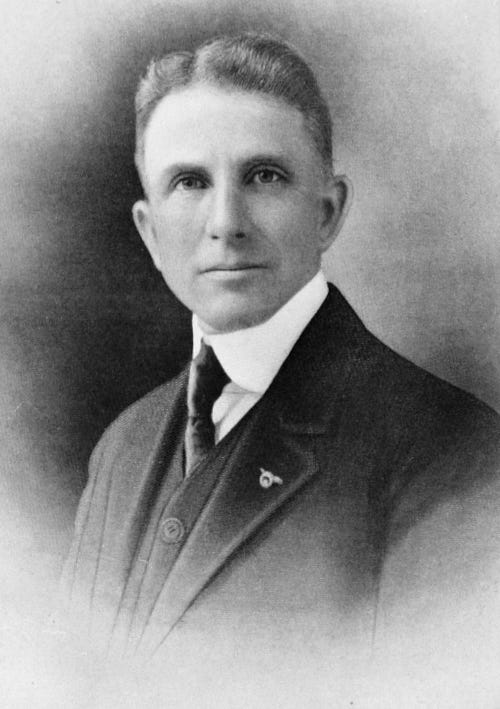
Which brings us back to Cyrus Avery. Avery is a businessman from Tulsa, and he leads Oklahoma’s highway commission. He also sits on the national board and on the small committee that works out which road gets which number. The road he cares about starts in Chicago, runs down through Illinois and Missouri, crosses Oklahoma, and continues on to California. It gets the number 60.
Notice who helped make the choice. Oklahoma is on the route, and Avery is on the committee. Illinois and Missouri are on the route, and they have representatives on the committee, too.
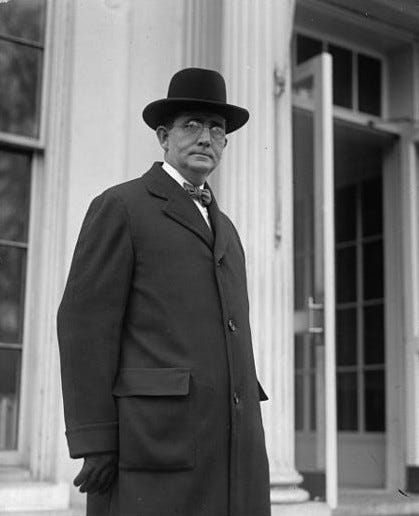
In Kentucky, Governor William Fields looks at the map and objects. His state has been left without a single one of those zero-ending routes. And 60, a number that would fit an east–west route running straight through Kentucky, has gone to a road that starts in Chicago and bends southwest instead.
In December 1925, Fields complains, “Chicago influence is written all over the map.” By January, he’s taken the argument to Washington, backed by Kentucky’s congressional delegation.
And it works. The highway officials agree to a switch. Kentucky’s road will get 60. The Chicago-to-Los Angeles highway will get 62.
Sixty-two. No zero.
That should settle it. Except now Avery is the one objecting.
“We have prepared our markers”
Kentucky has its congressmen behind it, so Avery writes to one of his own. On February 22, he sends a letter to Oklahoma congressman Elmer Thomas.
“It seems the entire Kentucky Delegation, including the Governor, are insisting on this change.”
Avery explains that officials have already offered Kentucky what a state really needs from this plan. A continuous highway across the state, all the way to the Atlantic. As he sees it, the only thing left to fight about is which number goes on it.
He keeps pressing. In March, he goes to the top. He writes to the president of the national association of state highway officials, the group that will have to approve the final map. Oklahoma, he says, and he personally, “strenuously object to any change of U. S. Route 60.”
Then comes a practical problem.
“We have prepared our markers and have them ready to put up.”
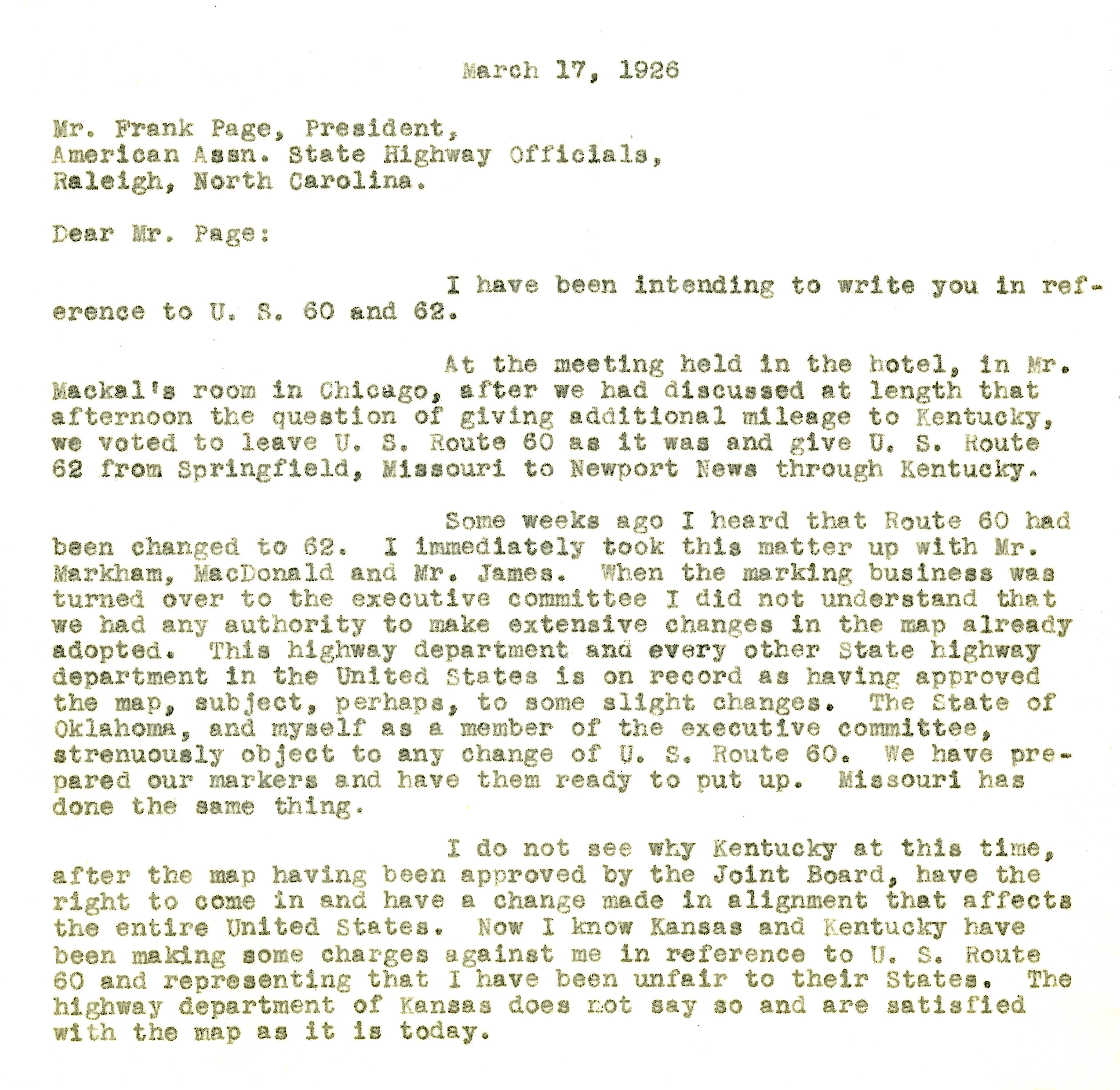
The Route 60 signs already exist. Missouri, he adds, has done the same.
So here’s the standoff. From Avery’s side, an approved plan is being changed after states have started preparing for it. From Kentucky’s side, the plan handed a special number to somebody else’s road.
Kentucky wants 60. Avery won’t accept 62. Somebody needs a way out.
The telegram from Springfield
On April 30, Avery is in Springfield, Missouri, with B. H. Piepmeier, a Missouri highway engineer. Missouri is on the road too, and it has its own Route 60 signs waiting.
And there’s a number nobody has claimed. Sixty-six.
It isn’t a zero, but it isn’t 62 either. The two men send a telegram to Washington. They’ll accept 66 if the other states along the road agree. It ends, “We prefer sixty six to sixty two.”
There it is. The number that we know today, in a message written to end an argument.
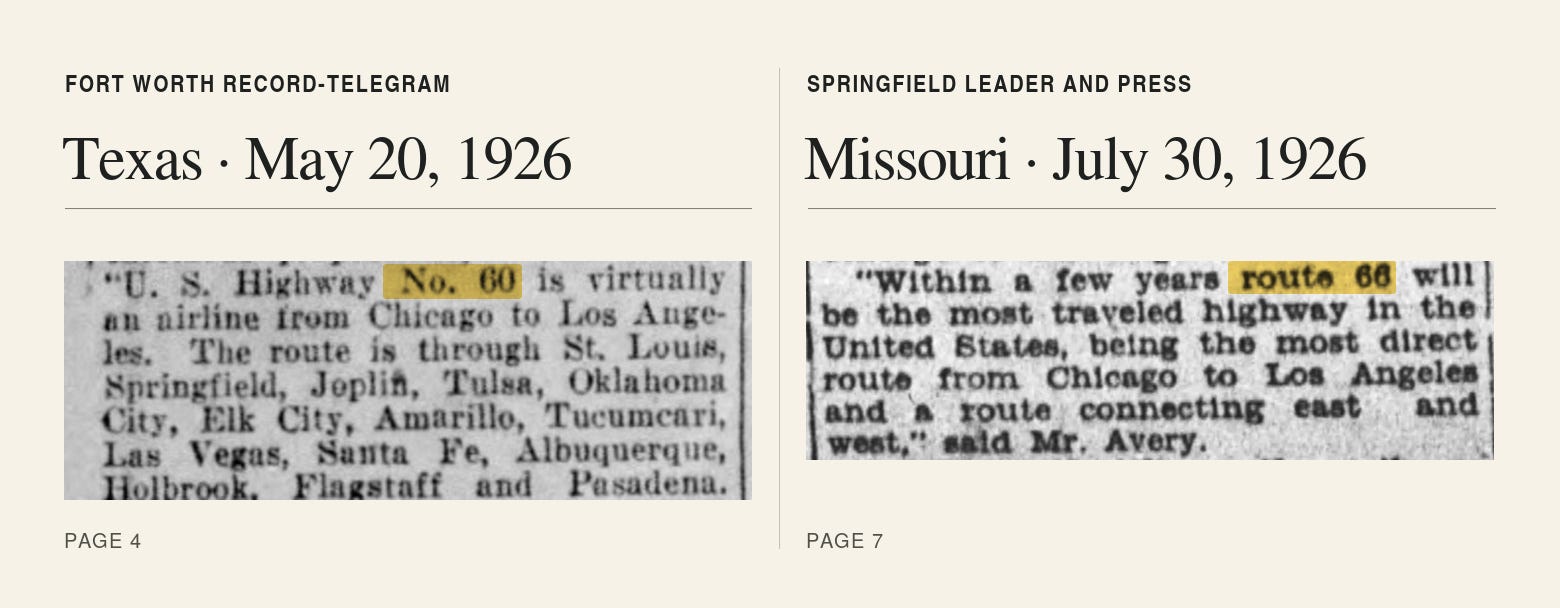
But a telegram doesn’t change every map overnight. It was a proposal, and the other states still had to agree. Three weeks later, on May 20, the Fort Worth Record-Telegram in Texas is still calling the road U.S. Highway Number 60. The article doesn’t tell us why the old number is there, but it’s a reminder that the change took a lot of time to spread.
And that article is worth reading for another reason. It lets us hear Avery the salesman. The paper reports on plans to bring highway officials from Texas, New Mexico, and Oklahoma together. Avery talks up a road linking Chicago to Los Angeles through places including Tulsa, Oklahoma City, and Amarillo.
He says westbound traffic has been traveling through Kansas and Nebraska, “to be lost in the mud and dust.” That’s Avery promoting his own route and taking a swipe at the competition. Whatever number ends up on that sign, he wants those cars coming his way.
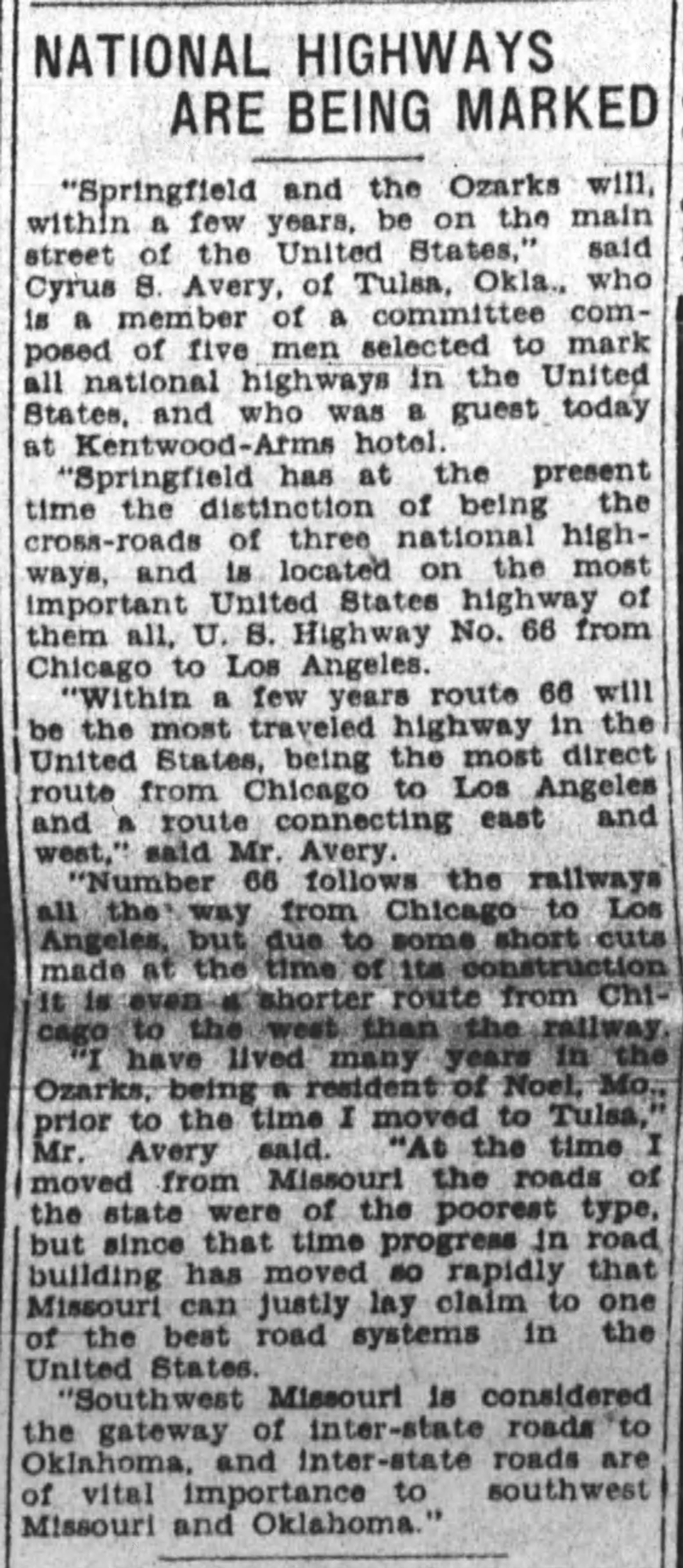
By July 30, the new number is unmistakable. Back in Springfield, Missouri, the Leader and Press runs the headline “National Highways Are Being Marked.” In the story, Avery predicts that Springfield and the Ozarks will soon be on “the main street of the United States.”
And this time, he names the Chicago-to-Los Angeles road as U.S. Highway Number 66. He tells the paper, “Within a few years Route 66 will be the most traveled highway in the U.S.”
That’s a prediction from a promoter. But listen to how completely he’s embraced the new number.
Then, on November 11, 1926, the national association of state highway officials adopts the numbered highway system. Route 66 has its place on the map.
Would Route 60 have become just as famous?
In 1926, 66 is just the number that settled the dispute. What comes afterward gave it all its meaning. During the Depression of the 1930s, families head west on Route 66 looking for work and a different life. After the Second World War, vacationers bring business to its roadside motels and attractions.
In 1946, a songwriter named Bobby Troup drives west with his wife, Cynthia, and writes a song about the road. Nat King Cole’s recording of it makes it a hit. Now you don’t even need a car to know the name of the road.
So would Route 60 have become just as famous? We’ll never know, but the connection between Chicago and California would still have mattered. The towns were still there. The people making those journeys would still have reasons to go west. But the song, the signs, and the number people came to recognize grew together. We can’t swap out the number and assume the rest of the story stays exactly the same.
In July 1926, Avery was already predicting a great future for the road. He could imagine the traffic before the song existed, before the television show, before the nostalgia. And just months earlier, he’d been fighting to put 60 on all the signs.
To me, the road gave 66 its meaning. But you can’t deny it. Sixty-six is a pretty cool number.
Thanks for listening - Chris
If you’re just listening to this, head over to hiddenlenshistory.com. You can subscribe for more, or find us on YouTube or Apple Podcasts or Spotify. We also find so many strange headlines that we made a game. Head over to madethepapers.com and see if you can spot the real headlines.


