

One hundred years ago, a Navy transport ship pulled into San Francisco with a math problem. The USS Chaumont had set sail from Japan on August 1st, with 128 passengers aboard. It arrived home in the U.S. on August 17th with 130.
Nobody had snuck on. The ship’s chief surgeon had a simple explanation for reporters waiting at the dock: “Two babies were born at sea.
Today’s article contains one affiliate link (Ancestry.com). If you sign up through it, I may earn a small commission at no cost to you
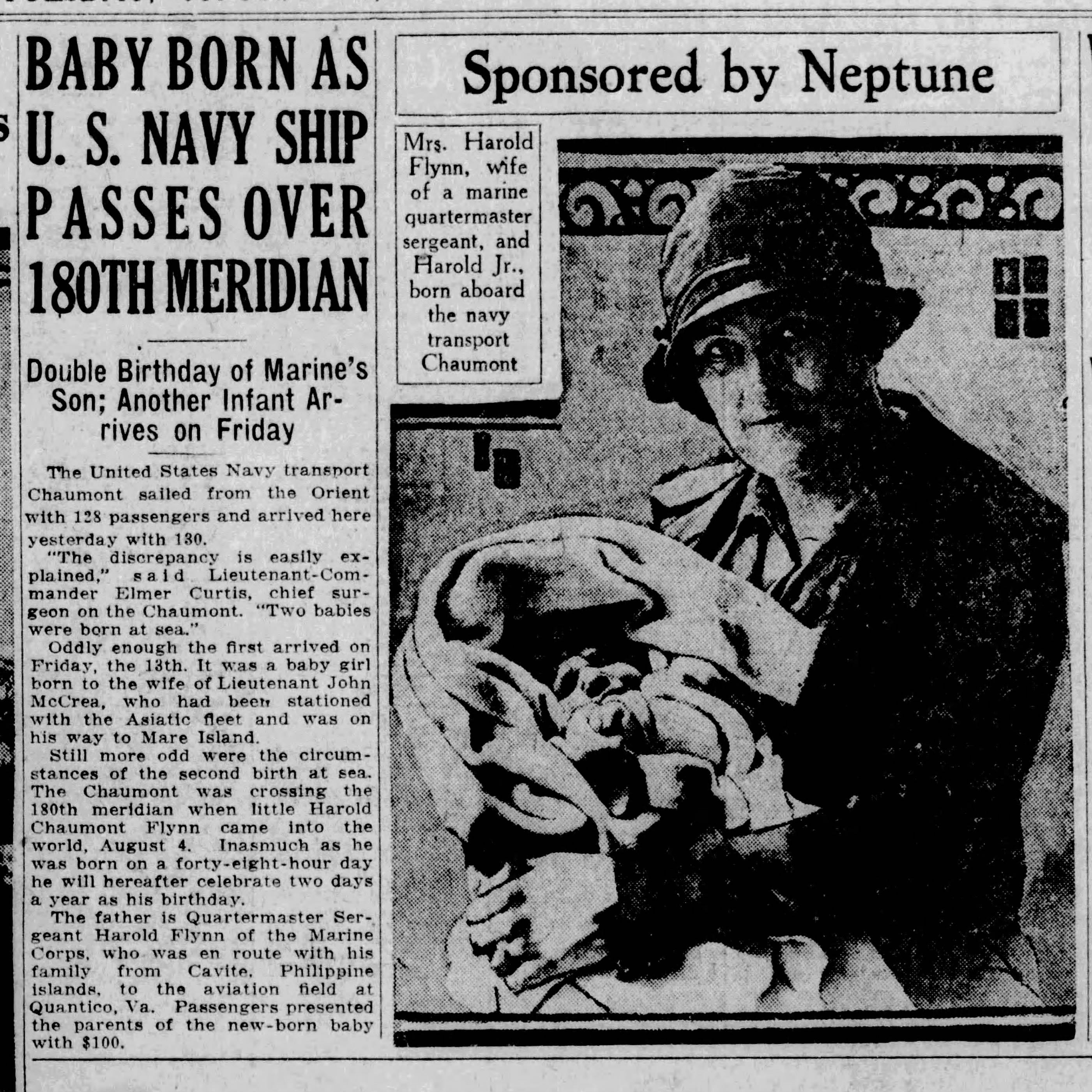
One of them was a girl, born on Friday the 13th, to a family also heading home from the Pacific fleet. The other was a boy named Harold Chaumont Flynn, and by the time the newspapers were finished with his story, he wasn’t just a baby born at sea. He was, they insisted, a baby with two birthdays.
Here’s what actually happened aboard that ship.
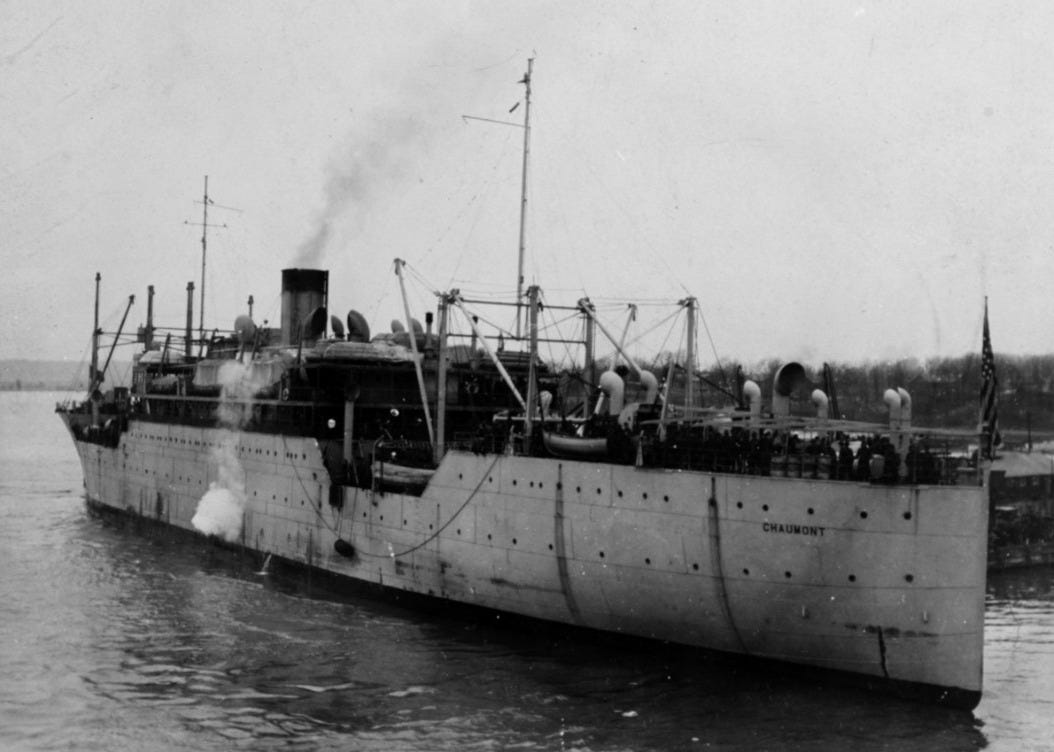
Harold’s father was Quartermaster Sergeant Harold Flynn of the U.S. Marine Corps. He, his wife, and their two young daughters were making the long trip home from the Philippines to the Marine base at Quantico, Virginia. Somewhere in the middle of the Pacific, on August 4th, Mrs. Flynn went into labor. That alone would have been a fine story. A baby, born at sea, aboard a military transport with a family already halfway around the world from home.
But the Chaumont was crossing the 180th meridian right around the same time as Harold’s birth. The International Date Line. And that’s where this stopped being an ordinary birth announcement to, according to the newspapers, something closer to a magic trick. One ran a photograph of Mrs. Flynn cradling her newborn son under the headline “This Baby Has Two Birthdays.”
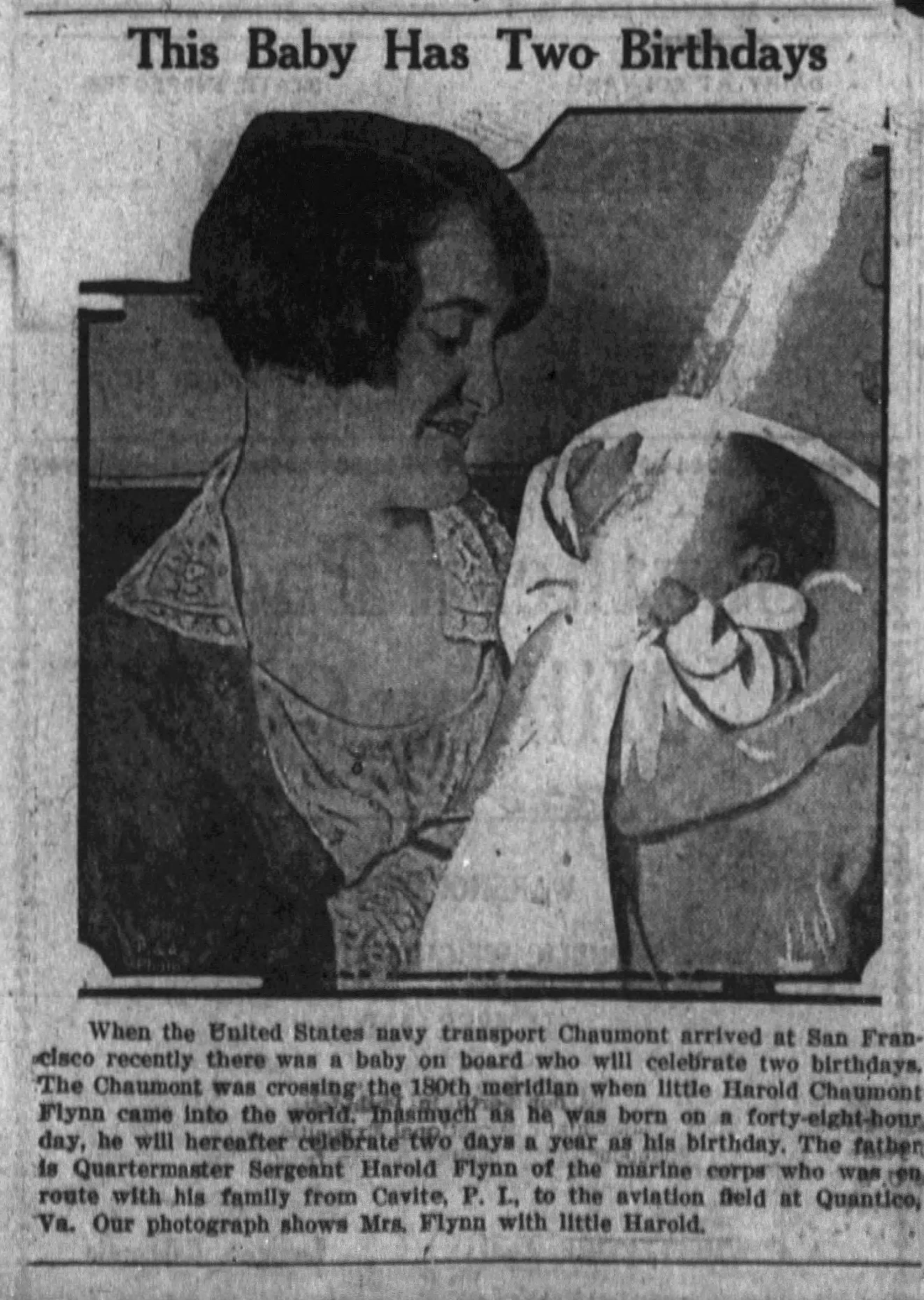
The paper declared,
“inasmuch as he was born on a forty-eight-hour day he hereafter will celebrate two days a year as his birthday.”
And the story kept traveling.
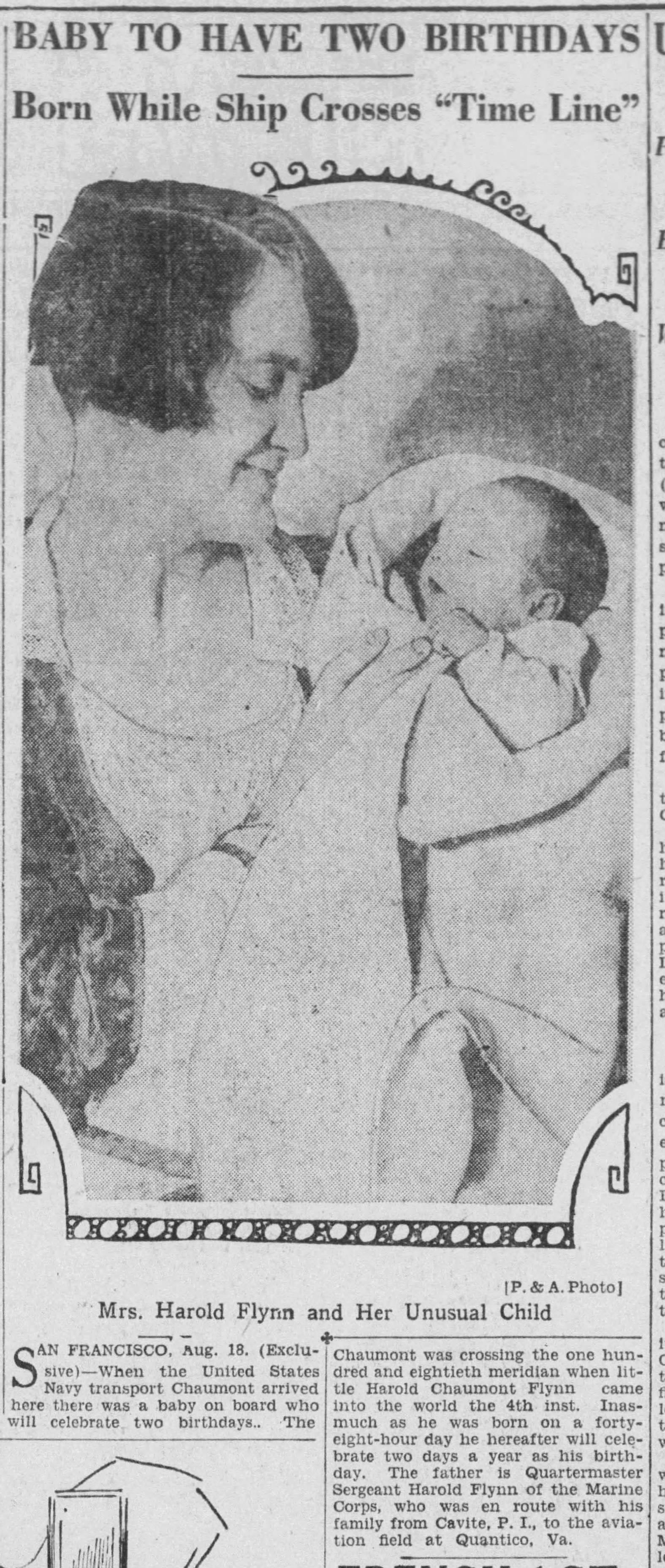
A Los Angeles paper ran Harold’s picture within days. By October, a paper near Scranton, Pennsylvania, Sergeant Flynn’s hometown, was introducing him to the neighbors as “Daddy” Flynn’s boy.
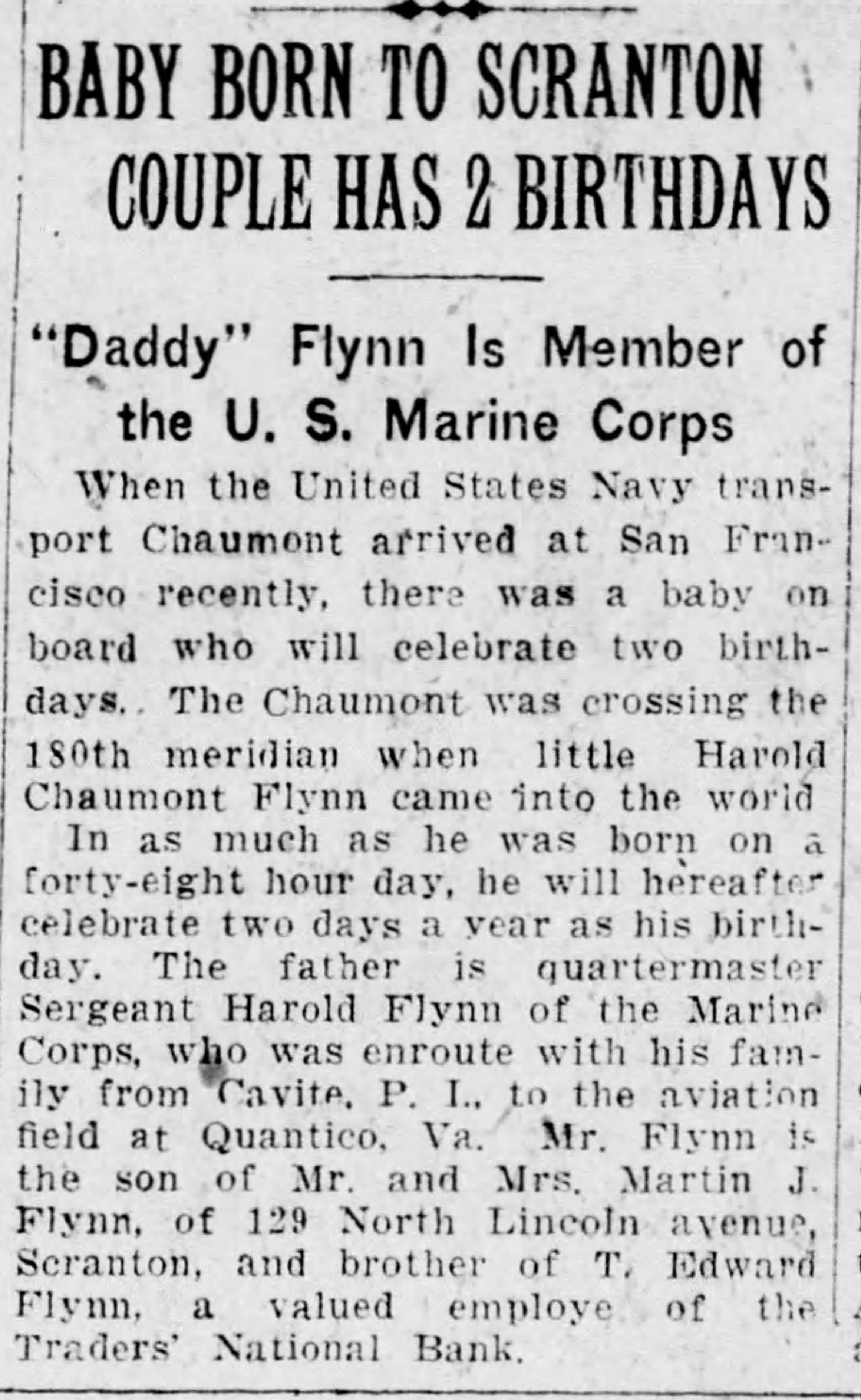
And by December, when the Flynn family finally made it home for the holidays, the story got its best telling yet.
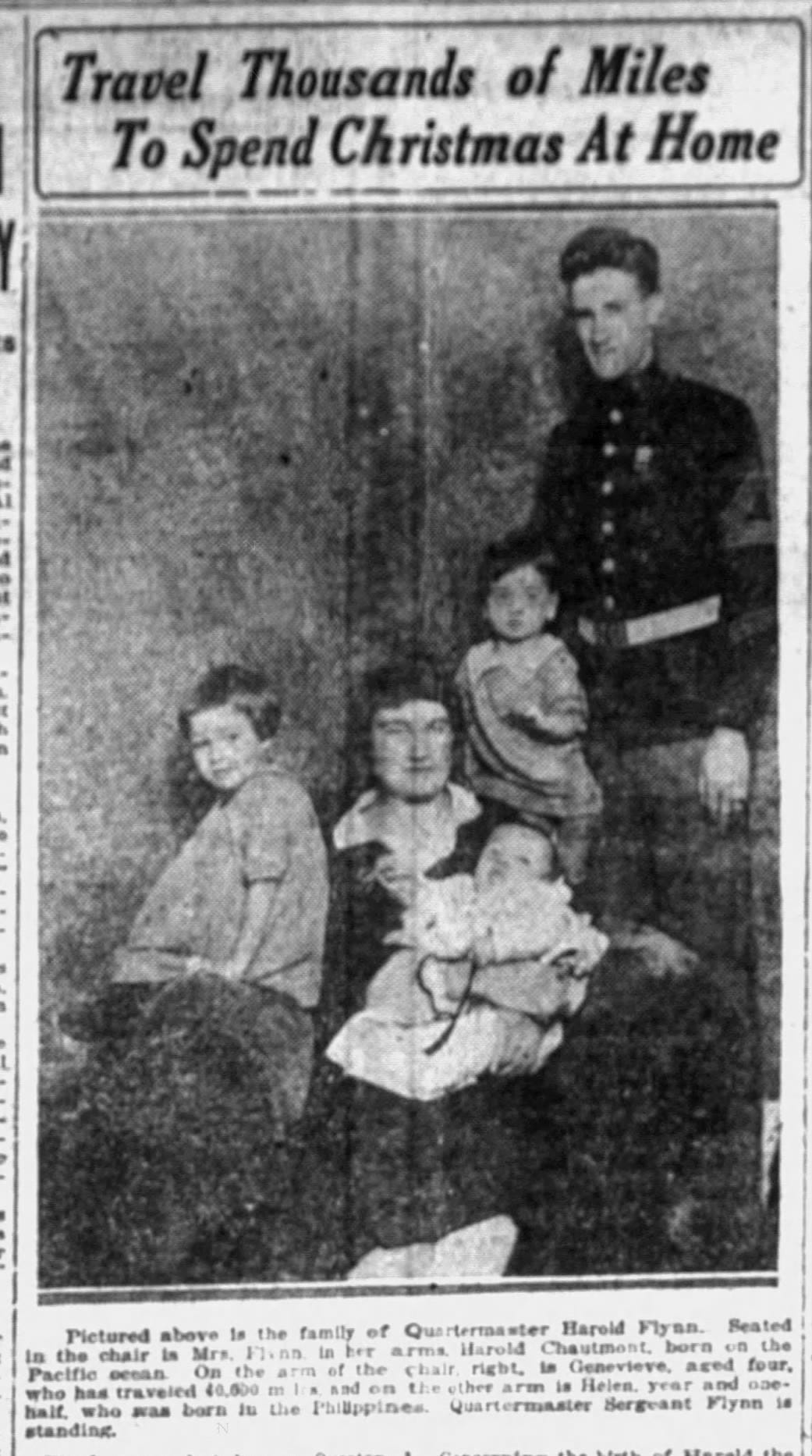
There they were. Sergeant Flynn standing behind his wife. Their two daughters beside her. And in her arms, four-month-old Harold, already a newspaper celebrity before he could even sit up on his own. The article laid out the math: twenty thousand miles, Manila to the Pacific, through the Panama Canal, up the Atlantic coast, to his grandparents’ front porch in Pennsylvania. Between the three Flynn children, they had already traveled farther than most people do in a lifetime. That December was the first time any of them had ever seen snow.
It’s a lovely place to end a story, and I almost did, but I was genuinely confused. The 48-hour-day explanation the papers gave was confusing. At least it was for me. If he was born on a day that lasted 48 hours, he’d still only have one birthday. It just happened to be 48 hours long that one time in his life. But that’s not really what was going on.
After looking into it, here’s what was happening.
If you cross the date line heading east (the direction the Chaumont was sailing) the calendar gets turned back one day. So let’s say his birth happened at 11pm. Depending on the exact position of the ship at the time, it could have been 11pm on August 4th, or 11pm on August 3rd, depending on whether they were over the line yet, or not. They genuinely didn’t know.
In 1926, a ship’s navigator didn’t have satellites telling him exactly where they were. Fixing their longitude precisely enough to know the exact minute they crossed that line was a careful estimate at best, using dead reckoning, star sightings, and math done by hand in a rocking cabin in the middle of the night. And on this day, with a woman giving birth on board too.
So faced with a birth nobody could precisely pin to one location, and thus date, one reporter decided that the fun answer beat out the accurate one. And honestly, I think it’s the right one, because “two birthdays a year” sounds a lot better than “we don’t know when this baby’s birthday is.”
But here’s where it stops being just a quirky 1920s headline, and becomes a little bit more personal. Harold lived to 79 years old, and his own gravestone lists August 3rd as his date of birth. Every 1926 newspaper prints the 4th. So whoever officially had to write it down, either believed, or decided, that the ship had already crossed the line by the time he arrived. If the ship’s actual log still exists, it might settle things, that is if somebody can track it down.
If anyone reading this has their own genealogical chops, or somehow gets their hands on that ship’s log, or is related to the Flynns, we’d love to know what you find. I ran out of time today, but I usually go looking for this sort of thing myself on Ancestry. (That’s an affiliate link, if you sign up through it, I may earn a small commission at no cost to you.)
It makes me wonder whether Harold Flynn ever knew. Did he grow up celebrating his birthday every year on August 3rd? Or did his family lean into it, and celebrate the remarkable uniqueness of his birth, and relive the whole story every August 3rd and 4th? I like to imagine the second one. A cake on the 3rd, and then another on the 4th. All because a bunch of sailors in the middle of the Pacific, and one newspaper reporter back on land, decided that’s how it all should go.
Either way, today’s 100-year-old headline led me to the kind of thing that may never have happened before, and may never happen again.
See you tomorrow. – Chris
Sources
San Francisco Chronicle, August 17, 1926, “Baby Born as U.S. Navy Ship Passes Over 180th Meridian”
Los Angeles Times, August 19, 1926, “Baby to Have Two Birthdays”
Wire reprint, “This Baby Has Two Birthdays,” October 1, 1926
Scranton-area paper, “Baby Born to Scranton Couple Has 2 Birthdays,” October 9, 1926
Follow-up feature, “Travel Thousands of Miles to Spend Christmas at Home,” December 10, 1926
Naval History and Heritage Command, official ship history, Chaumont (AP-5)
Naval Cover Museum, “Chaumont AP 5,” ship designation and commissioning record
Find A Grave memorial, Harold Chaumont Flynn, findagrave.com/memorial/19473277/harold-c-flynn
U.S. Naval Observatory, International Date Line explainer
NOAA, International Date Line explainer
Maritime Economics SA, worked example of eastbound date line crossing
USS Chaumont, U.S. Navy official photograph, via Naval History and Heritage Command