

Seven minutes.
That’s how long the movie ran before the chief of police walked in and arrested the owner of the theater. It wasn’t a surprise, either. He had announced it in the paper the day before. “I’ll be open on Sunday. Come get me.”
Well, they did. And this story, goes on for years.
I’m Chris, and this is Hidden Lens History. Every day, I open the newspaper from exactly one hundred years ago, find something worth sharing, and follow the story as far as I can.
It’s September 19th, 1926 and if you picked up the Springfield Leader in Missouri, you read the news that people still talk about today. The headline says, “HURRICANE WRECKS MIAMI, FLORIDA.” The entire city of Miami was in ruins.

The numbers reported that day were way below the actual damage. The eventual toll from the Great Miami Hurricane climbed into the hundreds. Partly because the eye of the hurricane passed right over the city. Everything went quiet and lightened up outside, so people came out thinking it was over. That’s when the back half of the storm arrived and wiped out even more.

But that story has been told. Right underneath that headline, in much smaller print, is the thing I found interesting today. That headline reads:
“GRAND THEATER TO PUT SUNDAY CLOSING ORDINANCE TO TEST.”
Springfield had a law making it illegal to show a movie on Sundays. The minimum fine was a hundred dollars. Maximum five hundred.
The law basically came from the infamous evangelist preacher Bob Jones, and the city council actually voted it down at first. So it went to the people instead, and the people passed it. Then somebody petitioned to undo it, twice, and both times the city voted to keep theaters shut on Sundays.
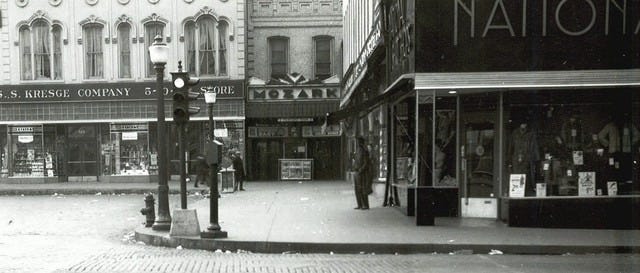
The man who owned the Grand Theatre, W. W. Smith, had a theory about why that happened. He said any businessman in town who publicly campaigned for Sunday shows would be taboo. He thought the votes weren’t actually measuring what people believed. They were measuring only what people would admit to.
The night before he opened the doors, Smith gave the paper a long written statement. And he came out swinging.

Every Sunday, he said, the trains and the automobiles carry thousands of Springfield people out of Springfield to go do the exact things they’re not allowed to do at home. So what are we accomplishing? Don’t ship our sinners to other cities and let them come back worse.
And then he threw down a dare. Okay. You want a holy Sunday? Then close everything. Every business, every ballgame, all of it. Make the whole day black and dreary. Or, admit you’re not going to, and let me open my theater.
Sunday comes. His doors open a little after noon and the theater fills up fast. Before a single frame rolls, Smith walks out onto his own stage. And in front of a packed auditorium gives a fifteen-minute speech about how this law is unconstitutional and they all know it.
The paper reports there was a loud applause.
Then he goes back and starts the film. Seven minutes later, the chief of police and the chief of detectives walk in with a squad and arrest him and four of his employees.
That night somebody put a sign on the door of the evening crowd. It said: “The police won in the first round.”

The first round. Two days later he told a reporter it was the greatest thing he’d ever done, and that he felt the way Lincoln must have felt freeing the slaves.

They gave him a jury trial in municipal court, where he lost, and was fined the minimum $100. So he appealed the decision up to the county court, and won. The judge looked at the ordinance and said the law was junk, and threw the case out.
Which meant Springfield suddenly had no ordinance to arrest anybody with. The city said they’d stop making arrests while they appealed it, and the Sunday after the county ruling, for the first time in about five years, people in Springfield legally walked into a movie theater on a Sunday afternoon.
Smith wasn’t there for any of it. Or at least his theater wasn’t. He sold the Grand before the year was out. Later reporting said the Sunday fight had a lot to do with it.
So now it was the city doing the appealing. Springfield pushed the case up the ladder, trying to get its law back. Not to Washington, like Smith had threatened, but to the Missouri Supreme Court.
Springfield lost. Smith won. The city did not get its law back. The court said the ordinance was unconstitutional. But why is the strange part. You’d expect church and state, right?
The court said the opposite. It said a city absolutely can shut things down on Sunday. That everybody deserves a day off as a public health concern, and it doesn’t magically become a religious law just because the day happens to land on the Christian Sabbath.
So Springfield had the power to do what it wanted. It just used it poorly. The original ordinance only named four things. Theaters, Playhouses, Vaudeville, and Moving pictures. It said nothing about circuses, fairs, football games, boxing, greased pig contests, wrestling, or anything else I’ve written about in 1926.
And the court said what’s the difference between those four and other things? All pull a crowd. All take people working to run them. All make noise on the quiet day. One of the judges put it in six words:
You can’t make fish of one and fowl of another.
And then the court went one step further, it said a law that hits some people but not others is easier to pass. Because the people you left out won’t fight it, and might even pick up business from what you want to shut down so would vote in favor of it.
All exactly what Smith had said when it all began (affiliate link) standing in his theater about to get arrested. Close everything, or close nothing. Unfortunately when Missouri finally backed him up, he’d already sold the theater.
Like this story? Share it with someone else who might, or subscribe to see what I dig up tomorrow.
See you then - Chris
Sources
Newspapers
Springfield Leader, September 19, 1926
Jefferson City Tribune, September 20, 1926
Springfield News-Leader, September 21, 1926
The Webb City Sentinel, September 22, 1926
Springfield Leader and Press, September 23, 1926
Springfield Leader and Press, September 24, 1926
Court record
City of Springfield v. Smith, 19 S.W.2d 1 (Mo. 1929) — CourtListener
Additional reporting
Ozarks First, “He knew Springfield police were coming. He started the movie anyway” — ozarksfirst.com