

One hundred years ago today, this was the front page in Omaha, Nebraska.
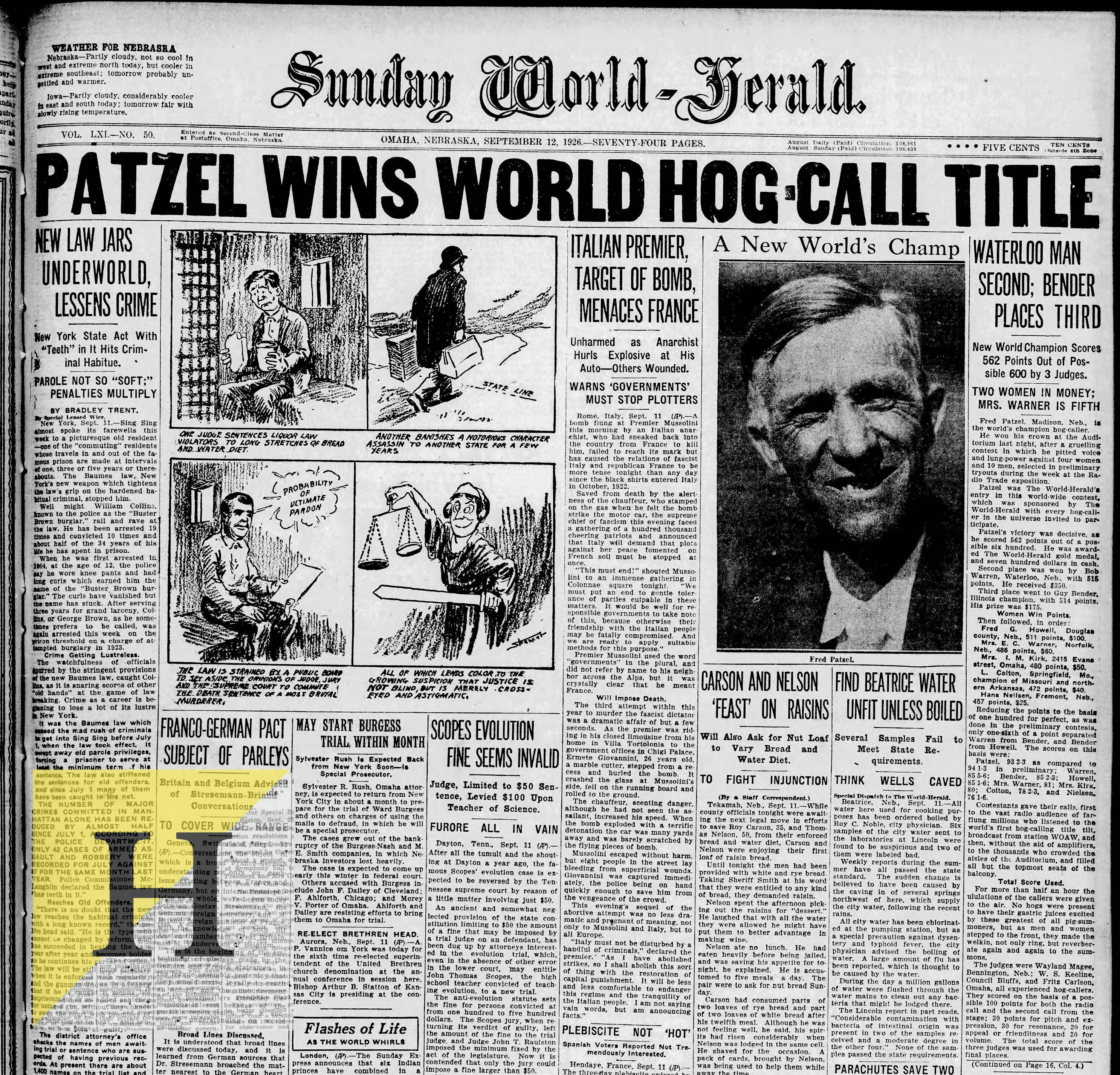
The banner across the top says “PATZEL WINS WORLD HOG-CALL TITLE.”
Below it, in smaller columns, Mussolini was target of a bomb. A new law jars the entire criminal underworld. Those stories just got columns. But the hog caller got the banner.
I’ll apologize in advance for those of you who already knew this was a thing. I had no idea. And since ‘hog calling competitions’ were new to me today, I hope I’m able to uncover a little something for everyone. And most importantly, tell you about Fred Patzel.
The Nebraska City News-Press ran “POOWEE DEFEATS HOOWEE OR SOOEE,” which is absolutely the best headline I’ve come across all year. The story describes a field of finalists surviving a week of “tonsil-devastating yodeling,” until only one man was left standing, and everyone else had gone hoarse.
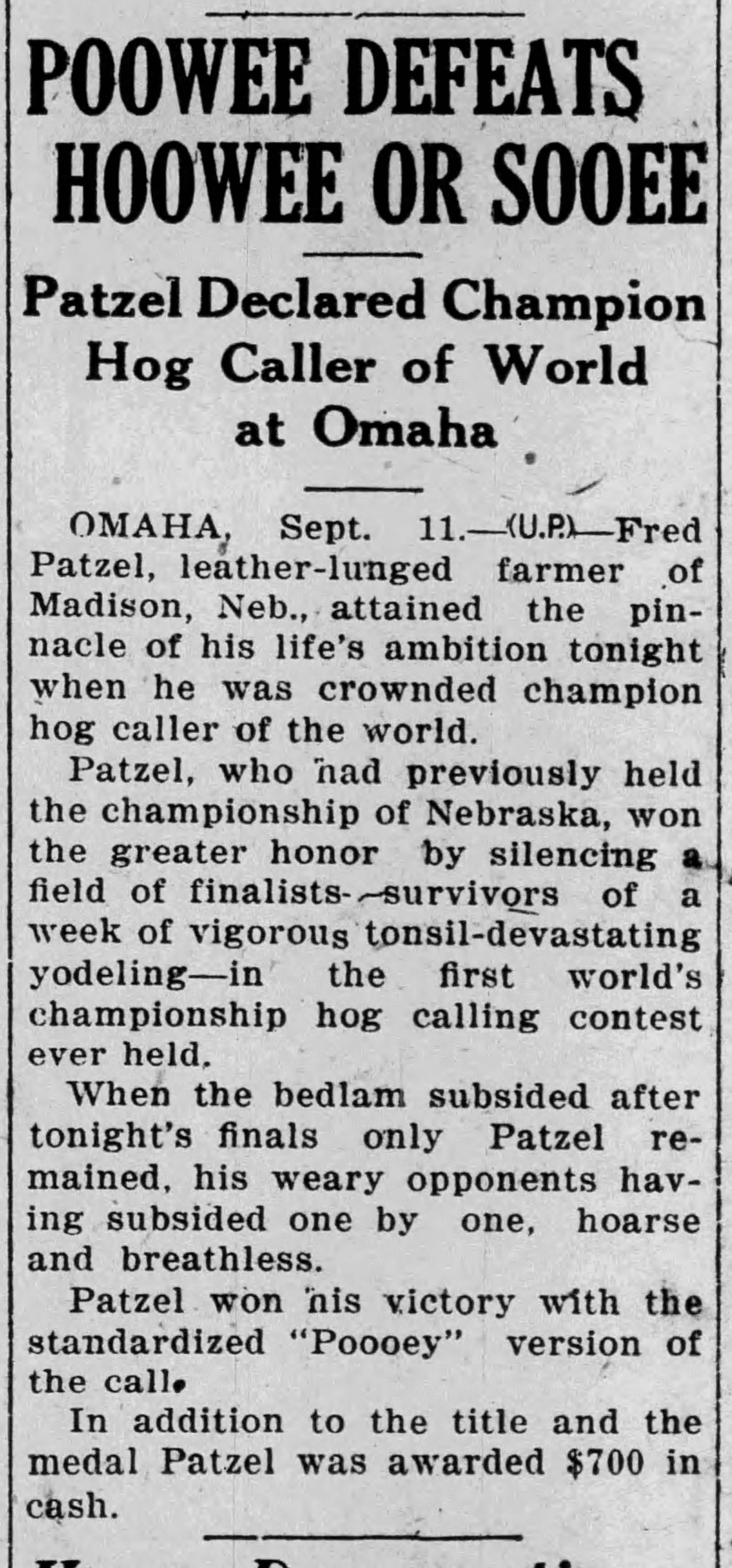
That man was Fred Patzel, and they describe him as a “leather-lunged farmer of Madison, Nebraska” who “attained the pinnacle of his life’s ambition tonight when he was crowned champion hog caller of the world.”
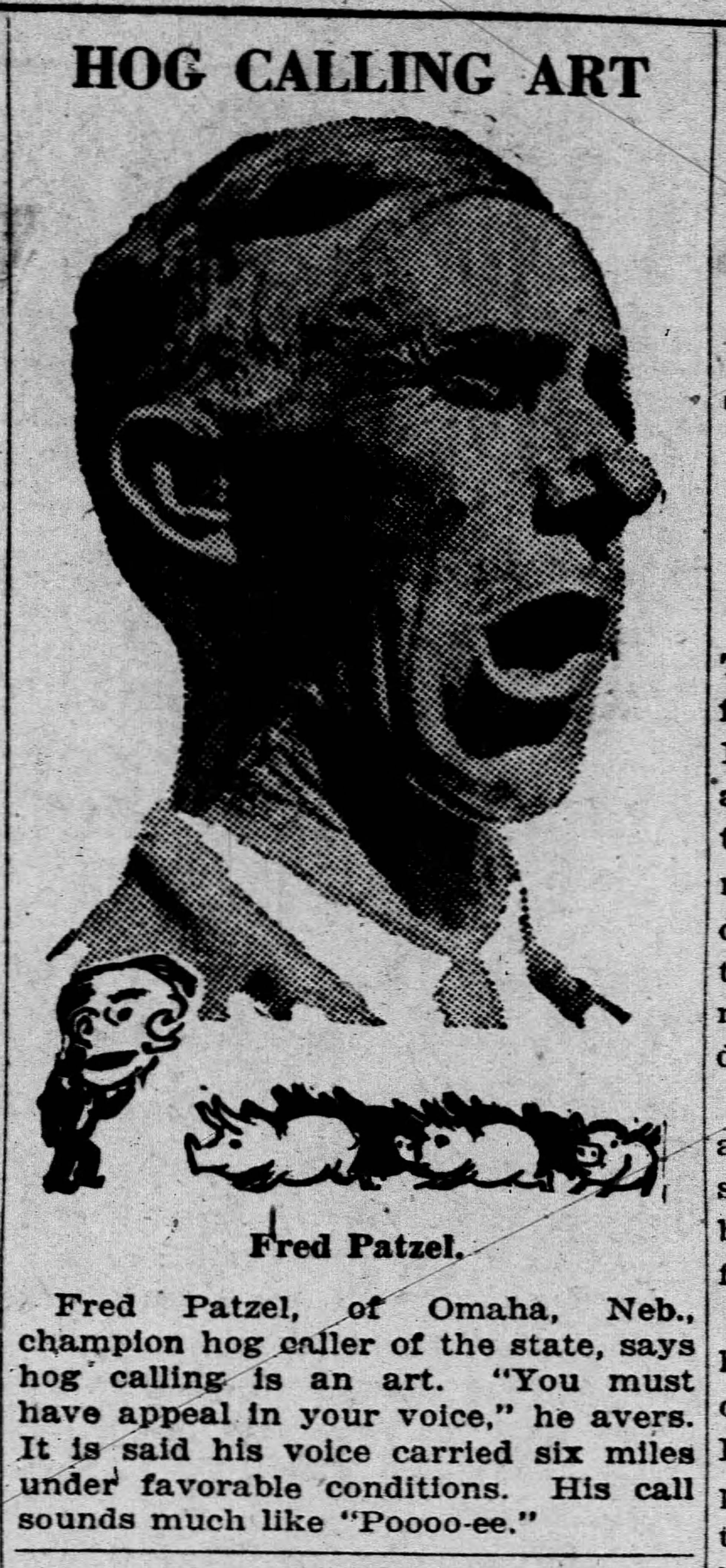
Hopefully you’re thinking what I was at this point. What is hog calling, and how do people compete at it?
Well, before electric fences and automatic feeders, hogs were spread across a lot of open space. And one of the only ways to get domesticated ones to come back, was your voice. The louder the better. If it carried a long distance, it usually worked well. For hunting purposes, it might also be used as an attempt to draw wild pigs nearer.
The Sioux City Journal reported that Patzel’s voice had carried six miles under favorable conditions. Patzel described his method as four escalating calls. The first was an introduction, the second an invitation, the third, an order. And the rest?
“A punch on the flanks of any lazy animal still lying in the mud.”
At this point I was still thinking this might be an old farm tradition that someone finally got around to holding a championship for, but that’s not what was happening here at all.
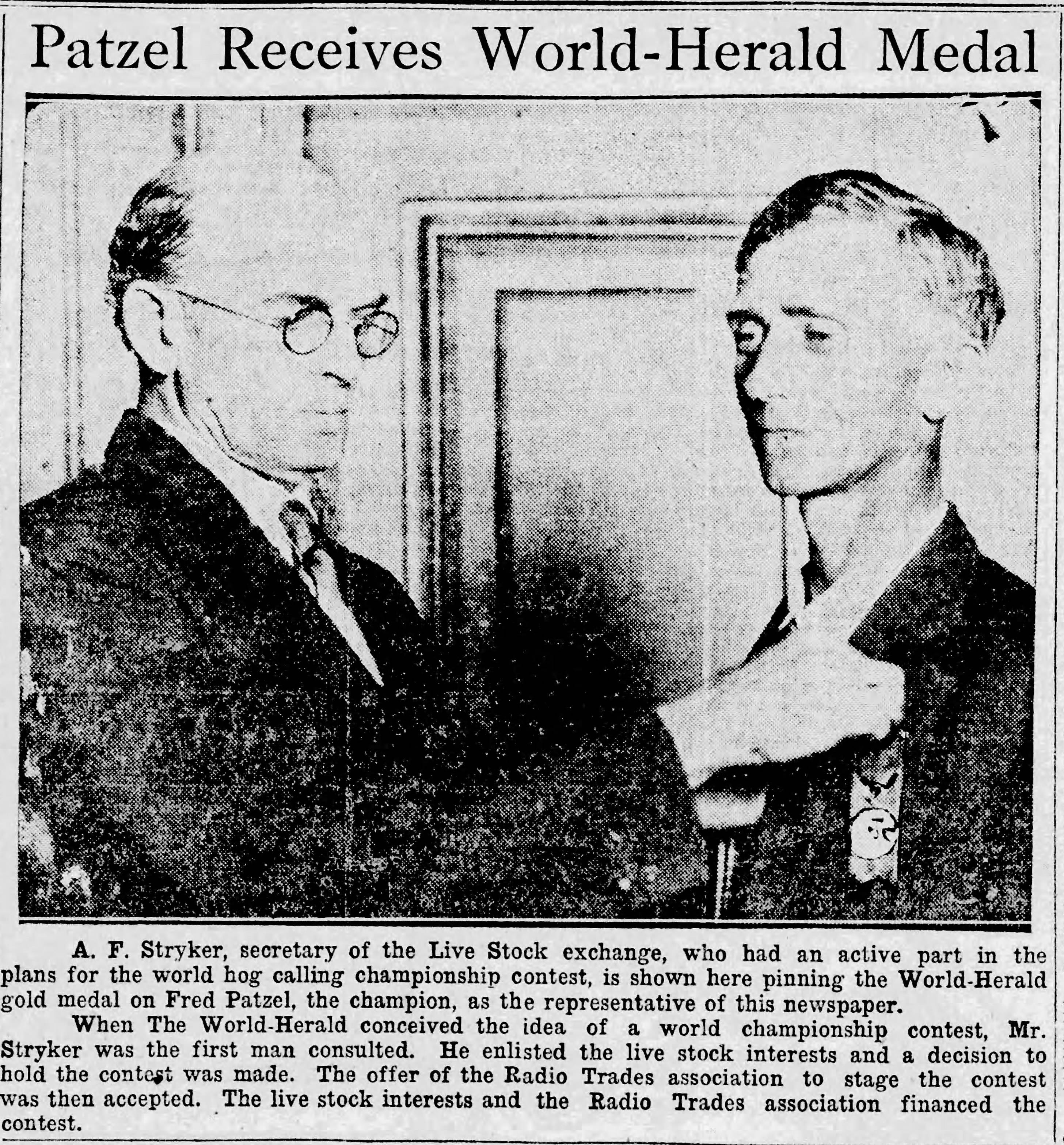
Another page has a photo of A. F. Stryker of the Live Stock Exchange pinning the medal on Patzel. The caption underneath explains the whole thing.
The World-Herald conceived the idea of a world championship contest. Stryker was the first man they consulted. He helped enlist the live stock interests, and also brought in the Radio Trades Association to stage and help finance the whole thing.
The contest was held during a radio trade exposition. It was broadcast over WOAW. Each caller gave one call over the radio and a second from the stage. Three judges scored both, and highest score possible was six hundred points. Patzel scored 562.
Pitch and expression were worth more than volume, and one of the scoring categories was “appeal or friendliness.”
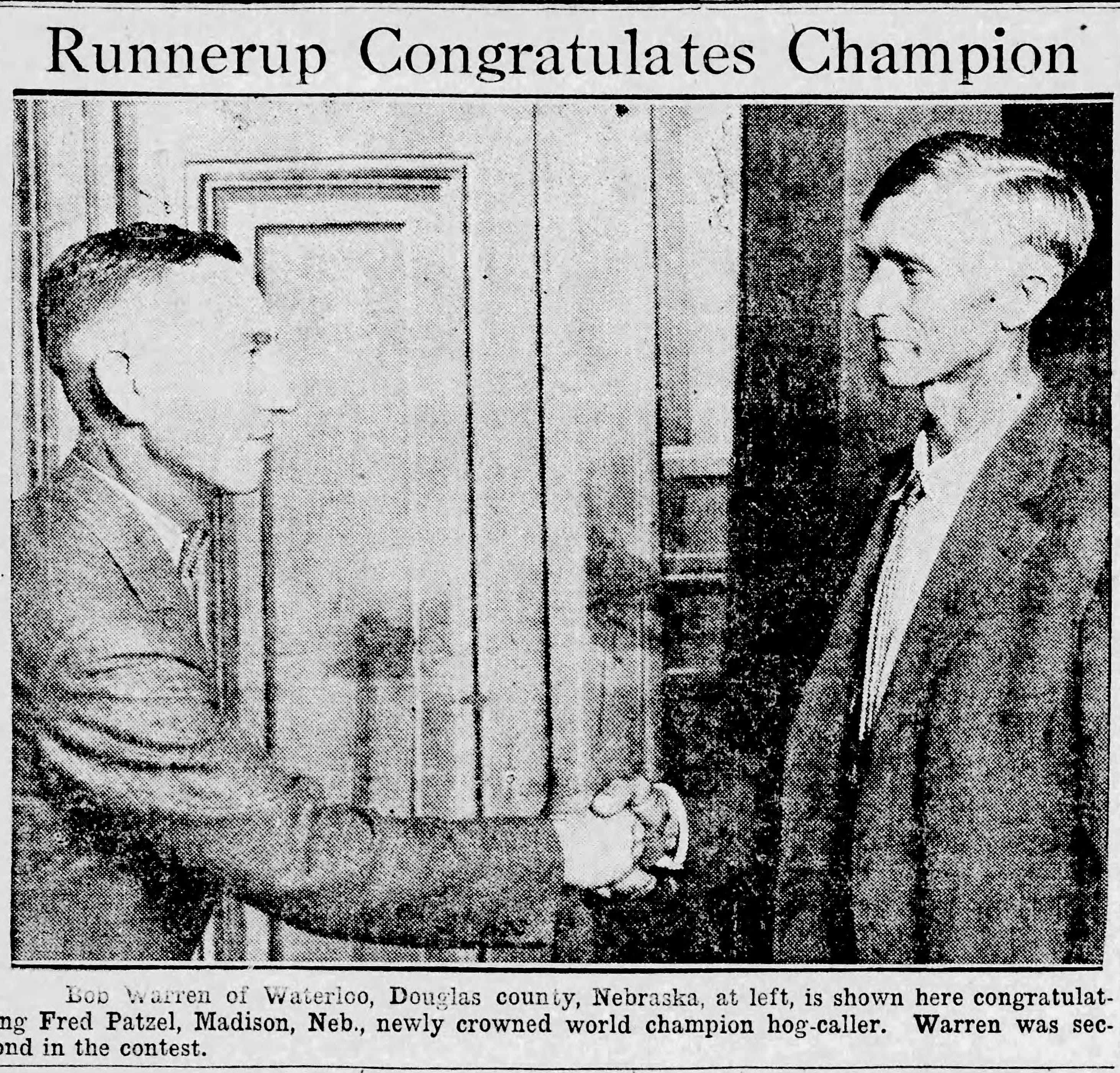
And many people entered. Nine states and the District of Columbia sent people to compete. According to History of Nebraska, 49 total entrants across the week, and 15 in the finals.
Bob Warren of Waterloo finished runner-up, and is photographed shaking Patzel’s hand displaying a quite dignified piece of sportsmanship for the hog-calling competition.
Patzel’s own reactions are the thing that stand out to me. He said he could get his teeth fixed now. He thought he might buy a few shoats and maybe milk a goat (Shoats were new to me. They’re young weaned pigs or a hybrid offspring between a sheep and a goat). He mentioned he’d never got past the second grade and “figured he ought to fix things so his wife and children would have a good living.”
Then he asked if there was a telephone around, because he wanted to call Madison and tell his wife he’d won. He’d promised her he would before he left, and said she had been a little doubtful that he would.
That’s when this story goes from heartfelt, to slightly absurd.
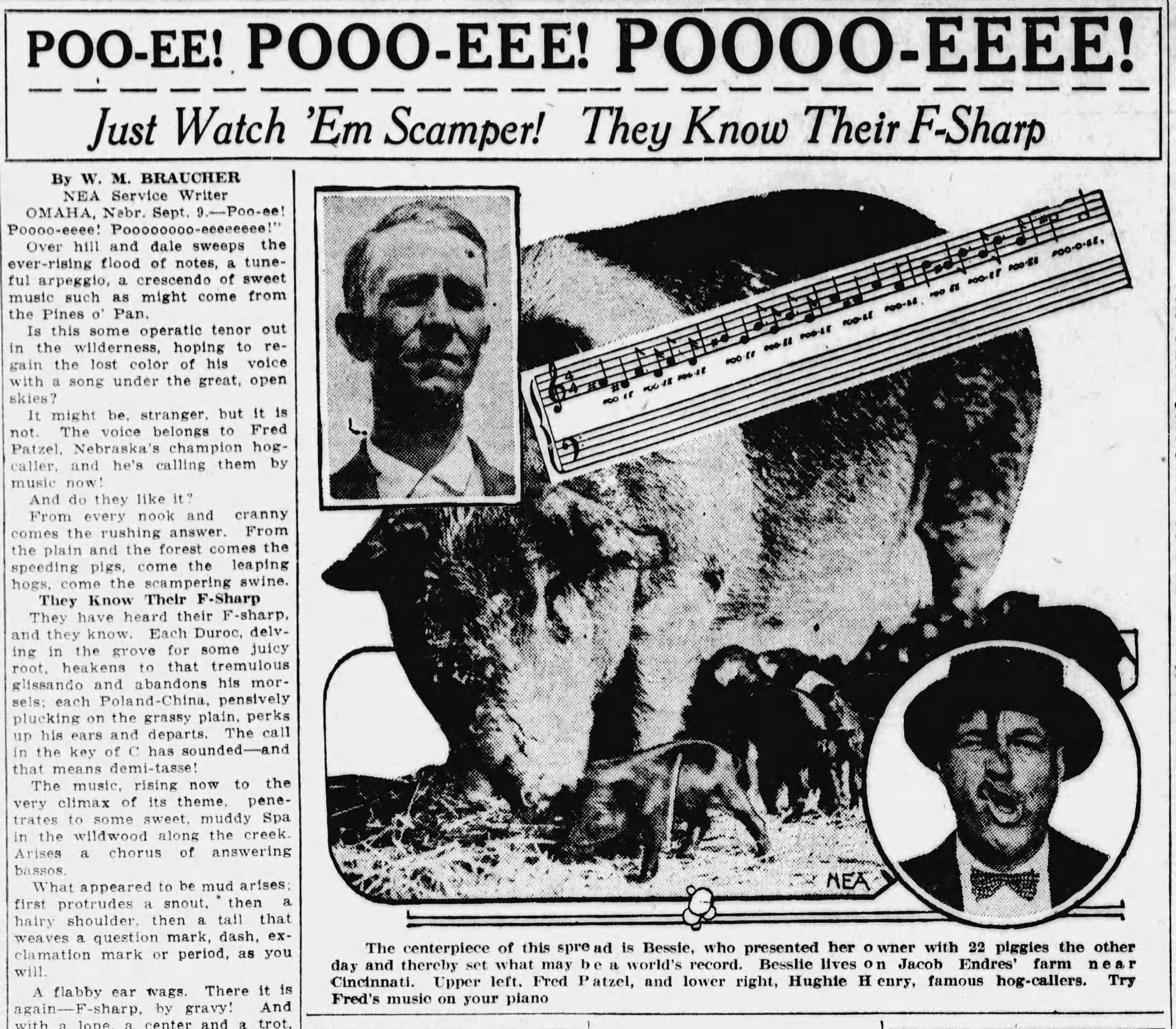
The NEA ran a syndicated spread that went out all across the country, headlined “POO-EE! POOO-EEE! POOOO-EEEE!” with a subhead about how the hogs know their F-sharp. “Just Watch ‘Em Scamper.” It’s written like a nature documentary narrated by someone who’s been over served. It also introduces rival Hughie Henry, the Pied Piper of the Kansas City stockyards,
They printed a musical notation of Patzel’s call, reportedly supplied by Patzel himself, and invited readers to try Fred’s music on their piano (attempt at your own risk). A Nebraska radio station even had him set the call to music on the air.
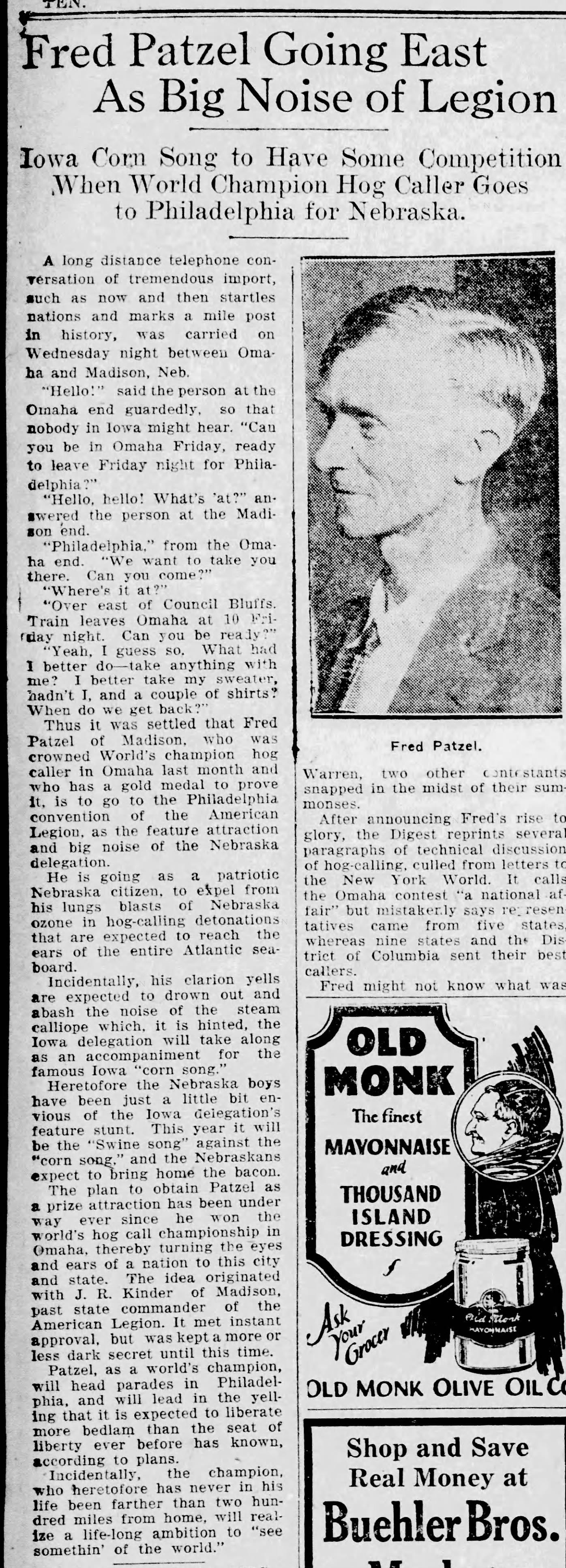
By October the American Legion wanted him in Philadelphia as the feature attraction of the Nebraska delegation. A direct attempt to upstage the Iowa corn song. The paper printed the phone call that arranged it. They offered Patzel to come. He asked, “Where’s it at?” and when told it was east of Council Bluffs, train leaving at 10 the next day, he said, “Yeah, I guess so, What had I better do—take anything with me? I better take my sweater, hadn’t I, and a couple of shirts? When do we get back?”
It says he had never in his life been more than two hundred miles from home, and would “realize a life-long ambition to ‘see something of the world.’”
Fred’s life was about to get even more interesting from there.
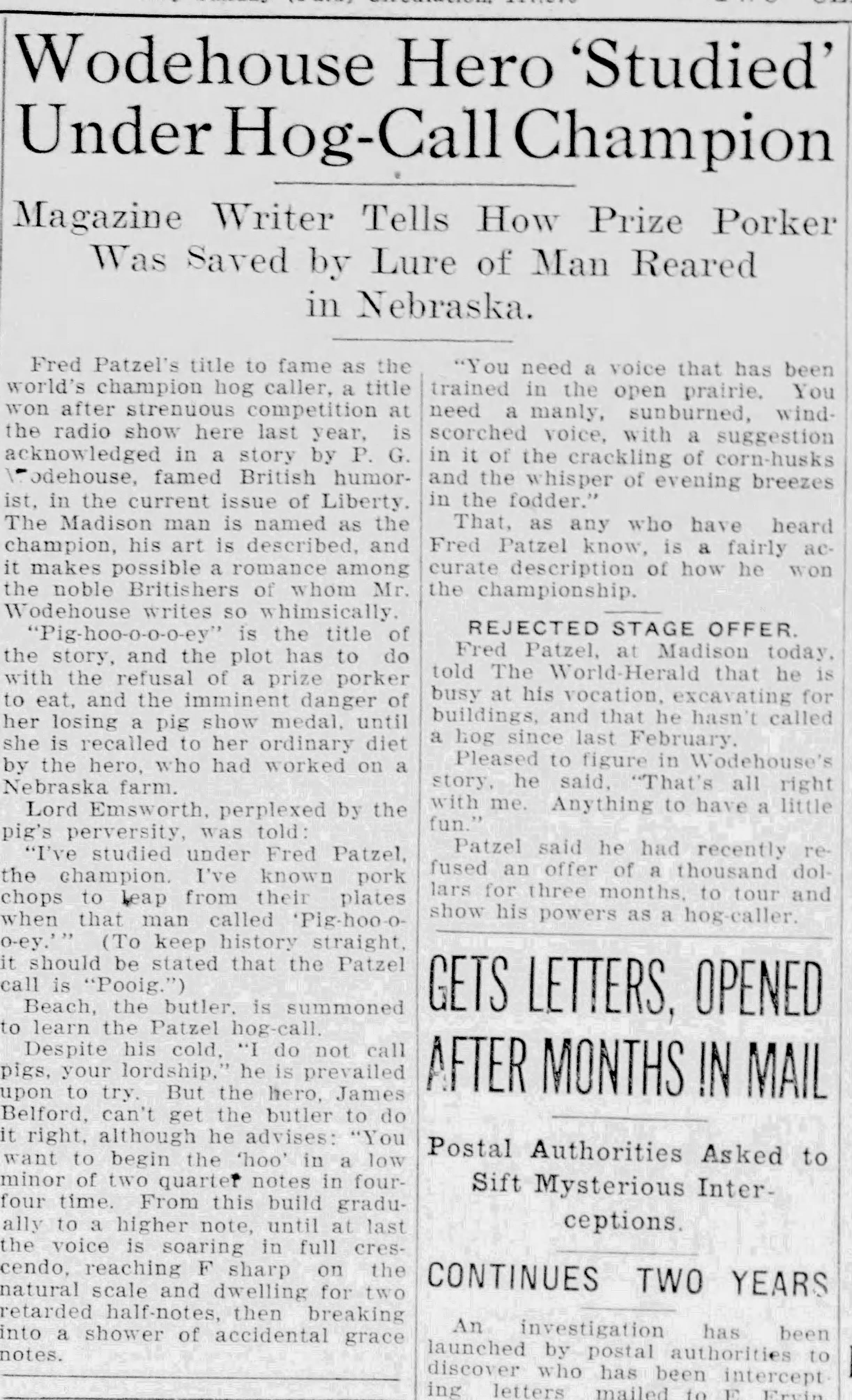
A year later in the summer of 1927, P. G. Wodehouse published a story in Liberty called “Pig-hoo-o-o-o-ey!” (Correcting itself in parentheses that Patzel’s actual call is “Pooig.”) The story goes that a sulking prize pig is refusing to eat. In danger of losing a pig show medal if it can’t be called to eat, someone who has studied under Fred Patzel himself helps the butler learn. As he struggles to do so, they say, “You need a manly, sunburned, windy-scorched voice, with a suggestion in it of the crackling of corn-husks and the whisper of evening breezes in the fodder.”
The article explains how Patzel was entertained to hear he was in the story. Told them he was busy digging foundations for buildings, and hadn’t called a hog since February. That he had just turned down a thousand dollars for three months to tour with his voice.
In February 1933 a Norfolk announcer talked him into a call during the noon market report. Patzel overloaded the broadcasting lines, blew out more than two hundred dollars in tubes, and the station had to go off the air for three minutes.
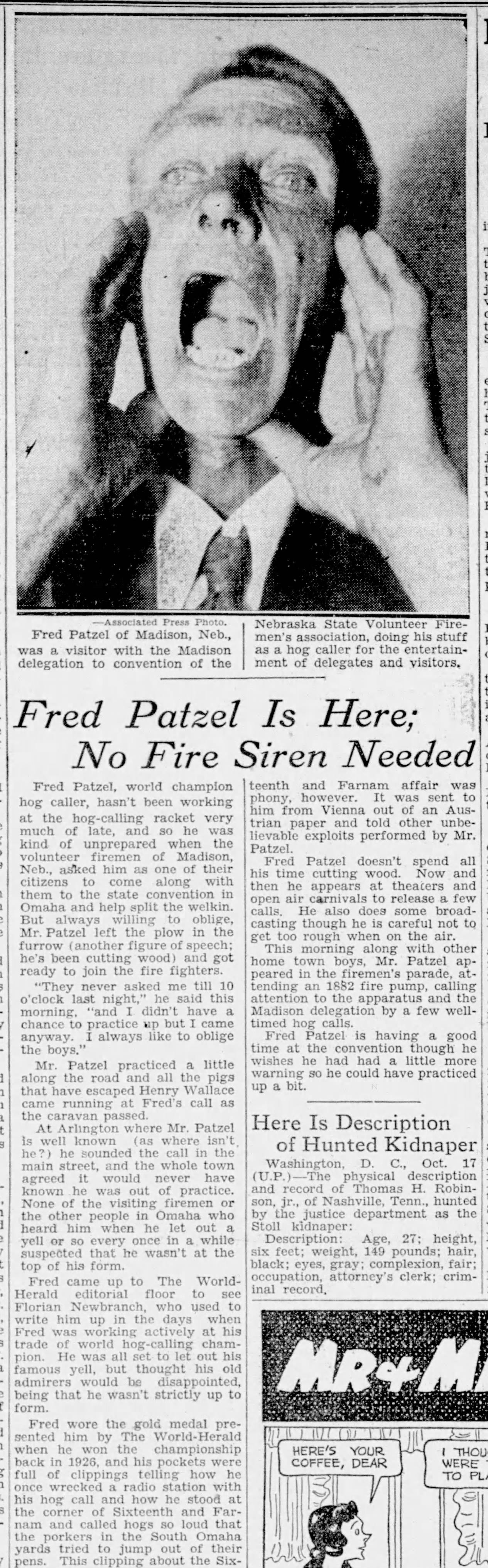
Eight years later from that first world-championship, Patzel agreed to visit the state volunteer firemen’s convention in Omaha. He agreed because he “always liked to oblige the boys.” He apologized for being out of practice and explained he’d been busy cutting wood.
This time he was wearing the World-Herald gold medal, and his pockets were full of newspaper clippings about his calling escapades. Some that were even made up. He wasn’t just cutting wood anymore. By then, he was appearing at theaters, open air carnivals, and doing some broadcasting.
This simple man we met back in 1926 really had embraced life in the hog-calling spotlight.
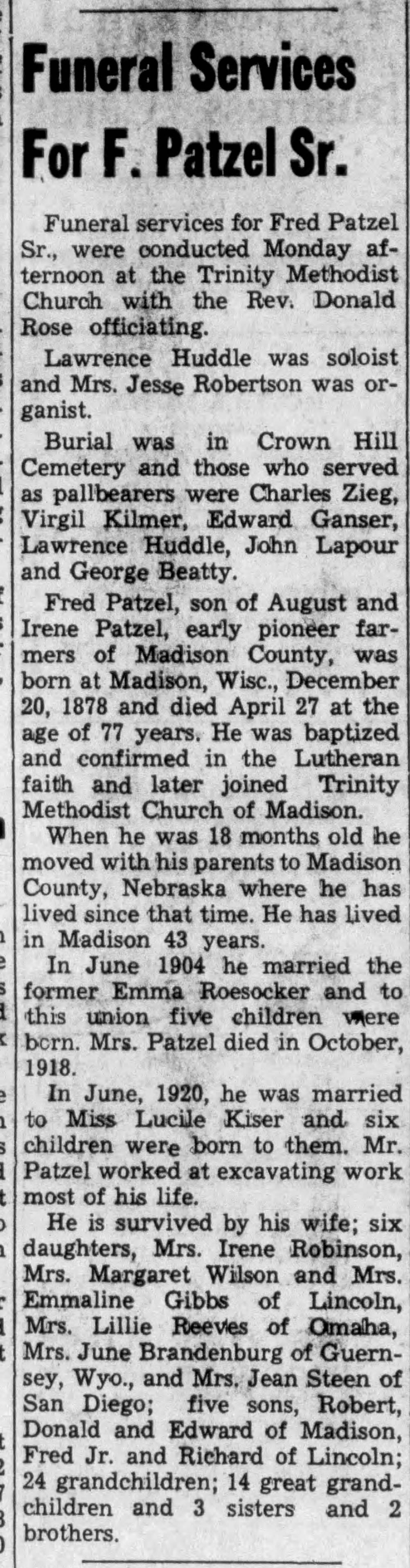
Fred Patzel died in 1956. His obituary in the Madison paper doesn’t mention that he had been a world champion hog caller. It said he was in the excavating business most of his life.
To me, the best part is Fred’s lasting legacy. Last month the Iowa State Fair just held the hundredth edition of its hog calling contest. Versions of this have been going on all over basically without interruption at least since 1926.
What also sticks with me today is that people are incredible. Learning about people like Fred is my favorite part of doing this. It also is more evidence to me that everyone has amazing skills inside them. And you can only hope that someday, everyone gets their chance to showcase them, like Fred.
See you tomorrow - Chris
Sources
Sunday World-Herald, September 12, 1926
Omaha World-Herald, September 12, 1926
Nebraska City News-Press, September 12, 1926
The Sioux City Journal, September 12, 1926
Sunday Times-Democrat, September 12, 1926
Omaha World-Herald, October 8, 1926
Evening World-Herald, July 7, 1927
Omaha World-Herald, October 17, 1934
James E. Potter, “Patzel’s ‘Poo-ey’ Piques Pigs’ Passion,” History Nebraska
Des Moines Register, August 2026