

On September 30th, 1926, Harry Houdini climbed into a coffin. But this time, he wasn’t trying to escape. There were no handcuffs, nobody threw him into a river, and the coffin wasn’t even underwater.
Instead, Houdini climbed inside. They sealed it airtight, and people in downtown Worcester, Massachusetts just stood around looking at him through the glass. For about an hour.
And if that isn’t strange enough, apparently this was supposed to be the exact coffin that Houdini would someday be buried in.
Thirty-one days later, he was… maybe.
I’m Chris, and this is Hidden Lens History. Every day I open the newspapers from exactly 100 years ago, find something worth sharing, then follow the story wherever it goes.
Houdini had been thinking about coffins a lot
If you read any newspaper in September 1926 , you would have already seen part of this story. Houdini was in Worcester performing his enormous touring show. But he was also experimenting with airtight containers.
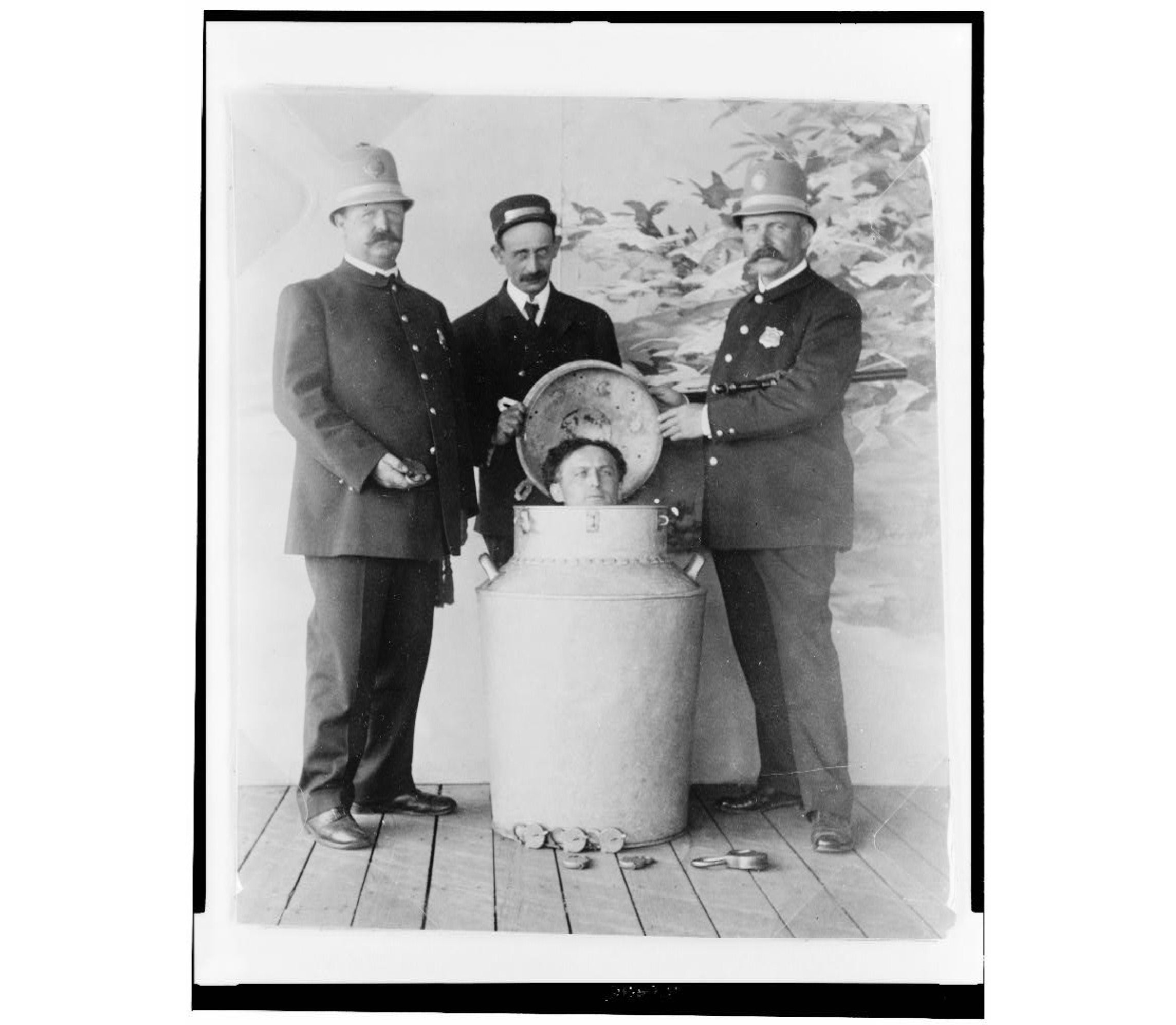
Earlier that summer, another performer named Rahman Bey had gained attention by surviving inside a sealed container. Claiming he did it using supernatural powers. Houdini said he didn’t believe his explanation.
In fact, by the 1920s, Houdini wasn’t just the world’s most famous escape artist. He had also become one of America’s most famous skeptics, and enemies of spiritualists. Houdini was willing to do something that looked impossible. He just wanted you to understand that there was a reasonable physical explanation for it.
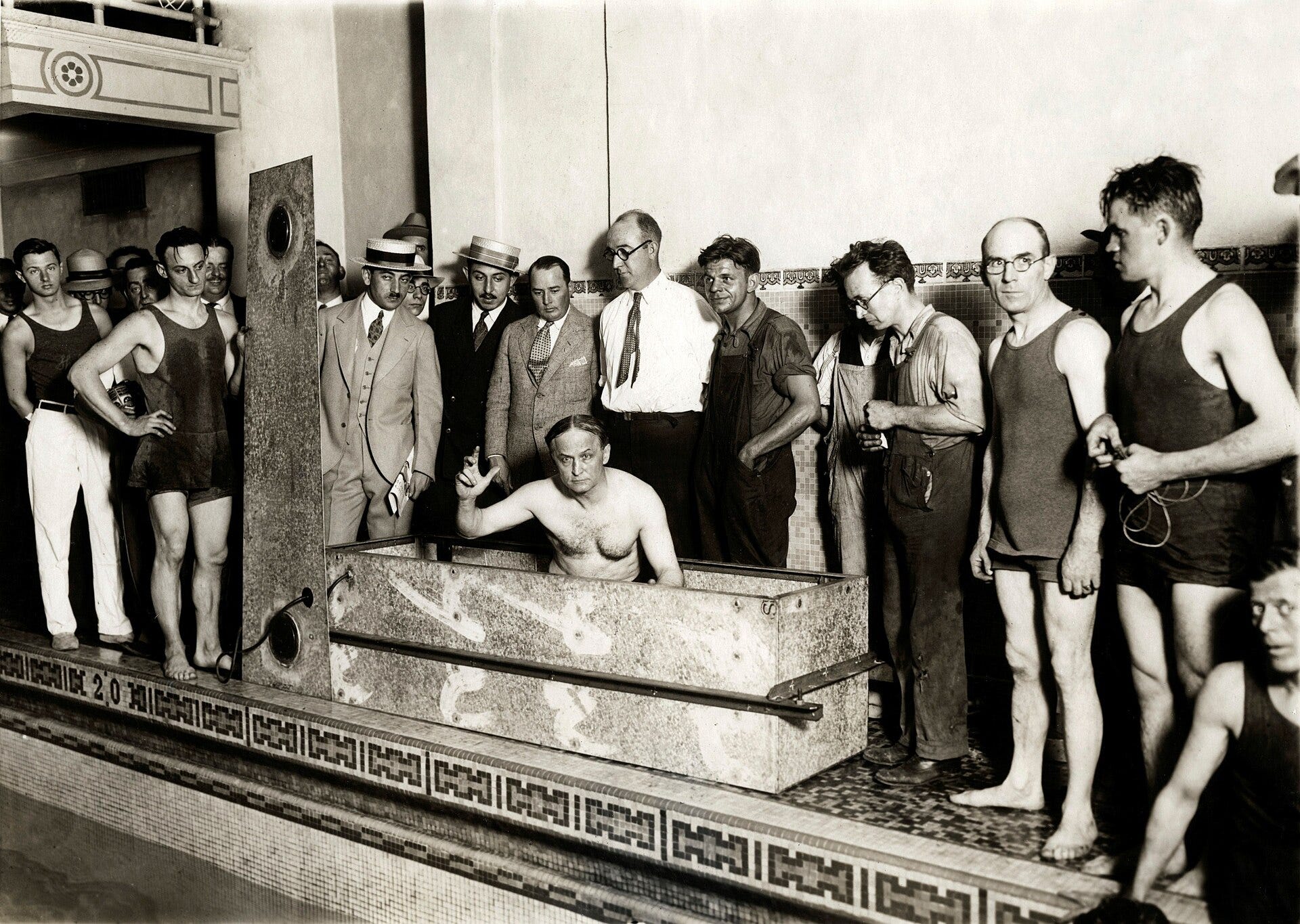
So on August 5th, he had himself sealed inside an airtight container and submerged in the swimming pool of New York’s Hotel Shelton. To show it was possible without supernatural powers.
He stayed inside for 91 minutes. Then on September 28th, he did it again at the Worcester YMCA. That test lasted about 71 minutes.
But today’s experiment was different. This time, everybody could watch.

The $5,000 coffin
The Worcester Daily Telegram had been promoting the event.
According to coverage, Houdini had ordered a specially-made airtight coffin with a glass top. It apparently cost $5,000, roughly $90,000 today.

It arrived in Worcester on September 28th, just a few hours too late to be used in the YMCA experiment. So instead, it went on display at Summerfield’s Furniture Company on Main Street. And then on September 30th, Houdini used it.
The advertising made the spectacle very clear. This was the first public test in full view of the people. You could just stand there and watch him. Then the newspaper advertisement added this shocking statement:
“…the coffin in which he will be buried when he dies”
An hour inside
The Worcester Evening Gazette reported on the stunt that very day. And its account gives us a surprisingly vivid picture of what happened.

Houdini climbed inside. The coffin was sealed. His assistant, James Collins, remained outside. And Houdini laid there. People gathered around. They could see him through the glass. When Collins asked questions, Houdini would respond by blinking. At some point, the inside of the glass began to fog with condensation. So Houdini wrote messages on it.

There was something stranger about this than Houdini’s other famous escapes. Usually, the drama came from not knowing what he was doing. He was usually underwater, in a box, behind a curtain, dangling from a building, and would then suddenly appear.
There was no reveal this time. People just watched him breathe for an hour inside a box.
Houdini was feeling great
That same day he sent a typed note to Moses Koenigsberg, the head of King Features Syndicate. “Have been busier than ever,” he wrote. Things were starting,“in a marvelous way.”
He’d spent three weeks in Boston after only planning on two. He thought he might set a record for business in Worcester. Then he listed where he was headed next. Albany, Schenectady, Buffalo, and finally, Detroit. Beginning October 25th, he expected to spend two weeks at the Garrick Theatre.
Nothing in that letter reads like a man contemplating his own death. He was 52. His show was a success. He was inventing new material, booking future engagements, and by all appearances, was delighted with how well things were going.
But the Detroit booking would be his last.
A few weeks later, Houdini reached Montreal. There, in his dressing room at the Princess Theatre, a student named J. Gordon Whitehead asked whether the magician could really withstand blows to the stomach (a stunt he had done many times before). Then he struck Houdini in the abdomen several times.

The famous shorthand version is that Houdini died because someone punched him. The medical history is much more complicated than that.
Houdini developed severe abdominal pain after that stunt. But he kept performing anyway, and eventually traveled on to Detroit. There, doctors diagnosed appendicitis. His appendix had ruptured, and peritonitis had set in. Exactly how those blows connect to his appendicitis has been debated ever since.
What isn’t disputed is the date Harry Houdini died at Grace Hospital in Detroit. October 31st, 1926. Halloween. Thirty-one days after the coffin test in Worcester.
Was he actually buried in that coffin?
Later accounts repeatedly say the glass-topped Worcester coffin was used after his death. Some describe it carrying his body back to New York. Others say parts of that special casket were used for his funeral. The Society of American Magicians’ own history says the family used the new casket to transport his body.
But surviving funeral photographs, and some conflicting descriptions, make the real fate of the Worcester coffin a lot less tidy than the legend suggests. So far as I can find today, we don’t know if he was buried in that same casket.
See another mystery about Houdini, was he was an actual Appleton-born Wisconsinite… or not!
See you tomorrow - Chris
Sources
Worcester Telegram, September 29, 1926.
Worcester Telegram, September 30, 1926.
Worcester Evening Gazette, September 30, 1926.
Worcester Telegram, October 1, 1926.
The Belleville News-Democrat, October 26, 1926.
Library of Congress, Item No. 96518807 — Harry Houdini 1908
Wikimedia Commons, August 5, 1926