I pull a lot of strange things out of the newspaper archive. But June 15th, 1926 gave me one of those before I even got past the headline.
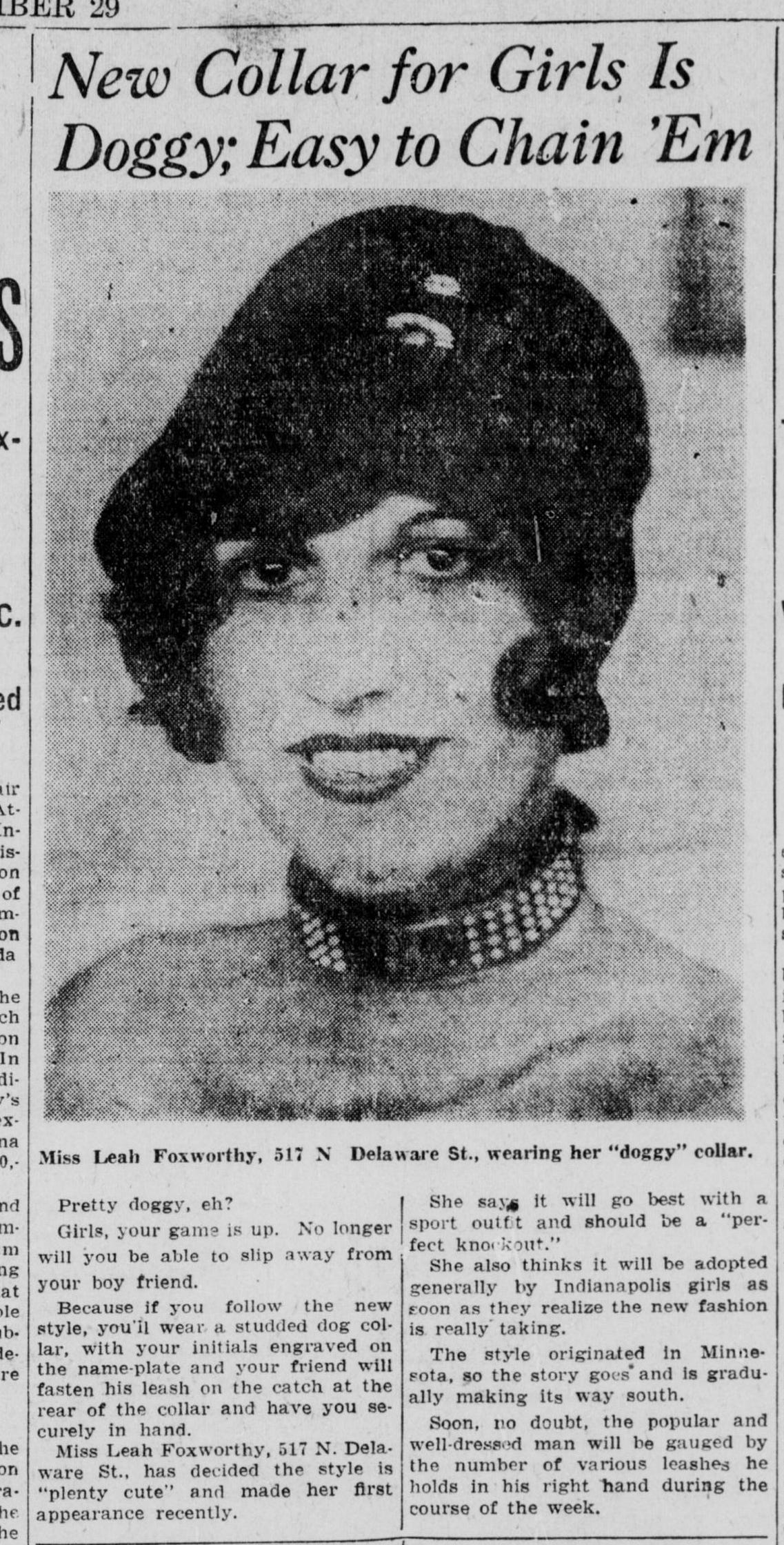
"New Collar for Girls Is Doggy; Easy to Chain 'Em."
WHAT’S GOING ON?
The Indianapolis Times opened its fashion piece with a line that I want you to read in full, because I could not improve on it: "Pretty Doggy, eh? Girls, your game is up. No longer will you be able to slip away from your boy friend."
The trend it was describing was a studded dog collar for women, with the wearer's initials engraved on the nameplate, designed specifically so that a boyfriend could attach a leash to the catch at the rear and have her, in the paper's words, "securely in hand." The style had originated in Minnesota, the story reported, and was gradually making its way south. The paper predicted that well-dressed men would soon be gauged by how many leashes they held during the course of a week, and that the popular and well-dressed man would be known by the number of various leashes he held in his right hand.
Miss Leah Foxworthy of Indianapolis, photographed wearing her collar, had decided the style was "plenty cute" and made her first public appearance in it recently. She thought it would go best with a sport outfit and would be a perfect knockout. She also believed it would be adopted generally by Indianapolis girls as soon as they realized the new fashion was really taking.
The piece was written without irony, without quotation marks around the concept, without any apparent awareness that describing a fashion trend in terms of a woman being leashed and held securely in hand might warrant a second thought. It was a fashion note. The editors saw no contradiction.
Which brings me to what was running in the same newspapers the same day.
THE OTHER STORY
The Morning Chronicle from June 15th, 1926 carried a brief item out of Glacier Park, Montana. Dorothy E. Pilley, described as a woman of high intellectual attainments and world-renowned mountain climber, would devote the summer to scaling Rocky Mountain peaks in Glacier National Park in an endeavor to show, in the paper's words, that there was not even any physical height achieved by the male of the species that a modern athletic woman could not reach just as handily.
The paper called her undertaking a "peak grabbing match, catch-as-catch-can" between woman and mere man.

Dorothy Pilley was not a minor figure. She was a genuine climbing pioneer who had made first ascents in the Alps and written seriously about mountaineering at a time when women in the sport were a novelty to be remarked upon rather than a presence to be reckoned with. She spent that summer in Glacier National Park doing exactly what the paper said she would do, and she did it without a nameplate or a leash attachment.

WHIPLASH
What stays with me about June 15th, 1926 isn't the dog collar story on its own. That's easy to process as a historical artifact, a relic of a time that we’ve mostly moved past (although I do believe there was some recent controversy about Sydney Sweeney in some photo shoot wearing a leash). At least something to roll your eyes at and scroll on.
But what gets me is the fact that both of these stories existed in the same newspapers on the same morning, and nobody in any of those newsrooms appeared to notice the gap between them. In fact, there was also an entire article about the advancement of women.

On one page, a fashion trend premised on the idea that a woman slipping away from her boyfriend was a problem requiring a leash-based solution. On another, a world-renowned climber heading into the mountains specifically to demonstrate that no physical achievement of men was beyond the reach of women. A third, shows just how far women were getting in business, politics, etc.
It’s a strange strange world we live in.
See you tomorrow
-Chris
Sources
Indianapolis Times, June 15, 1926.
Morning Chronicle, June 15, 1926.
Winchester Sun, June 15, 1926
