

Police send five loaves of bread down a river. Four keep moving. But one stops. They throw grappling hooks into the water beneath it.
And there was the woman they’d been looking for.
This is Hidden Lens History. Every day I open the newspapers from exactly 100 years ago, find a story that makes me stop, and follow the paper trail as far as I can.
This one starts with Mrs. George Lewis of Bridgeport, Connecticut.
She and her husband had been camping for two weeks on the Housatonic River. They were planning to break camp and head home to Bridgeport that Tuesday.
Sunday morning, about ten o’clock, she told her husband she was going to take the small rowboat and go fishing along the river. He had no reason to be fearful. She’d been fishing many times herself before. So he stayed back at camp to get ready for the drive home.
It was only later, when he realized she’d been gone much longer than usual, that he went looking for her. Other campers joined in the search. They found the rowboat partially submerged. Mrs. Lewis was not in it.
Senior Sergeant W. E. Bushy of the Connecticut State Police was called in to search. He brought along eight recruits who were in training when the call came in.
And when discussing strategy for the search, Bushy remembered something from his childhood. Something about putting bread on the water.
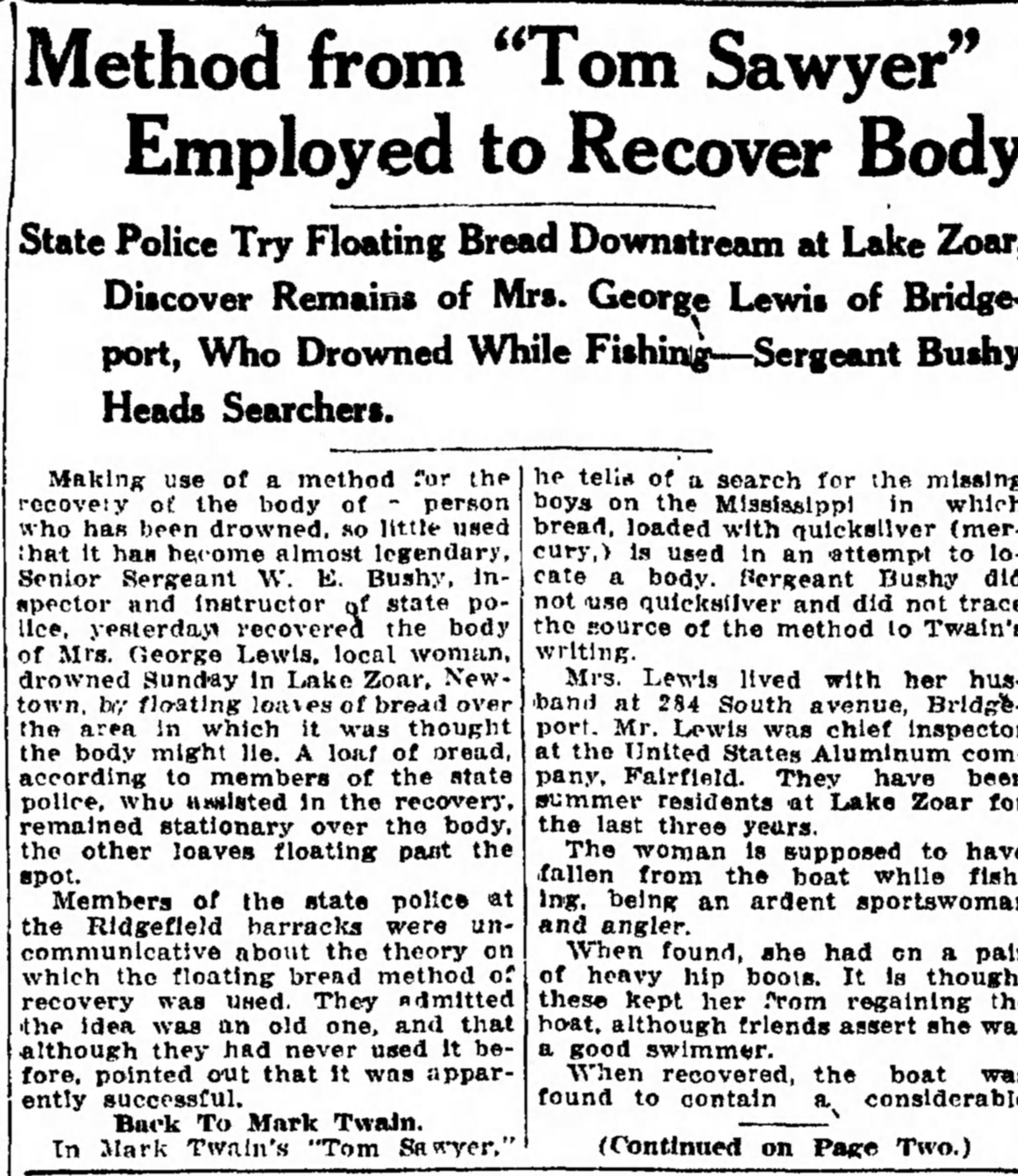
So Bushy set out five loaves into the water. For a few minutes they floated together. Four of them kept moving on, but one didn’t. It just stopped.
The searchers grappled the water in the area underneath that loaf, and hours later recovered Mrs. Lewis’s body.
This is where I became a little skeptical about the method. But I looked into it, and instead of finding differing accounts. I kept finding the same story, with little explanation.
The local paper reported.
“Members of the state police at the Ridgefield barracks were uncommunicative about the theory on which the floating bread method of recovery was used.”
So pretty much it worked, but they couldn’t explain why. The article says the police admitted it was an old idea, and that they’d never used it before. But, as far as they were concerned, it had worked.
A couple of weeks later, TIME magazine picked it up and gave the whole thing a little blurb under its “Science” section.
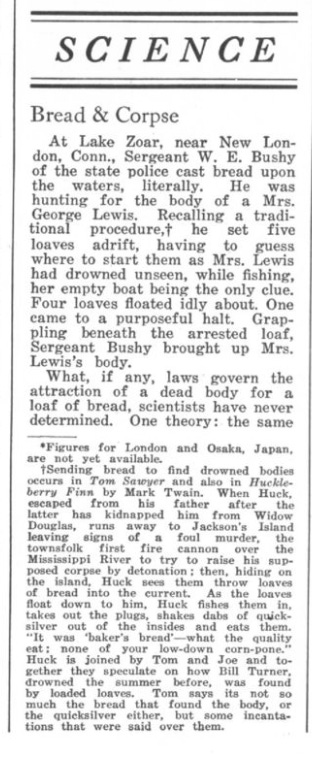
Their headline was “Bread & Corpse.”
And all of the coverage was making another connection to Tom Sawyer. The Bridgeport Telegram put it right in the headline:
“Method from ‘Tom Sawyer’ Employed to Recover Body.”
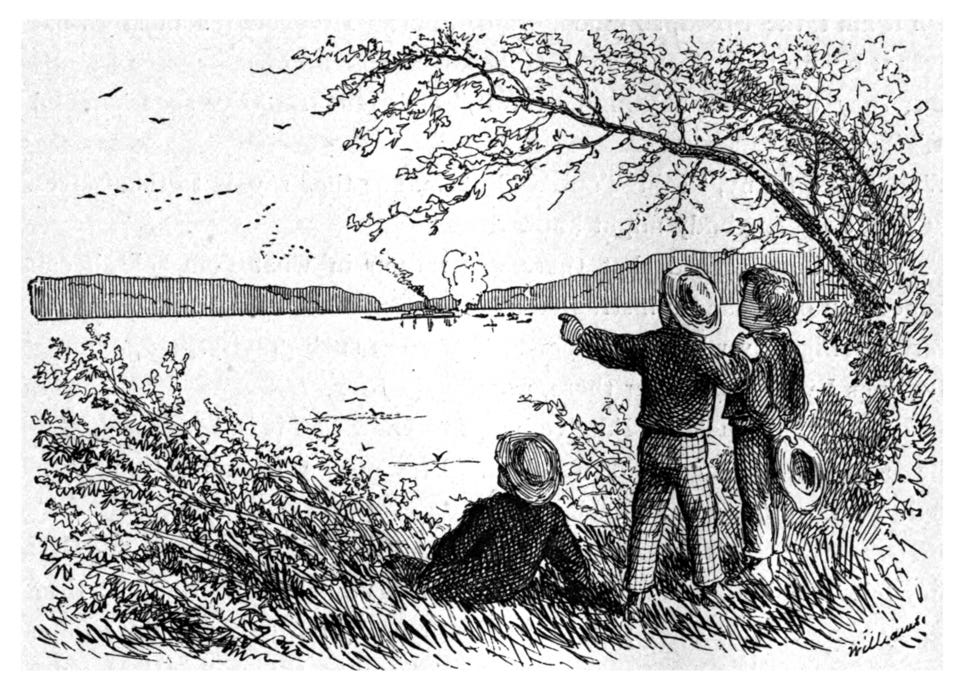
And there is actually a scene like this in The Adventures of Tom Sawyer. I hadn’t read it in decades so had to go find it. Sure enough, Tom, Huck and Joe are hiding on Jackson’s Island. They hear a cannon booming out over the Mississippi and eventually realize people are searching the river because everyone back home thinks the boys have drowned.
Dig through the archives yourself at Newspapers.com → I may earn a commission if you subscribe through this link.
Huck explains that people take loaves of bread, put quicksilver inside them (which means mercury) and let them float downstream. The belief was that wherever there was a drowned body, the bread would stop.
That’s almost exactly what the Connecticut papers were describing fifty years later. Except, apparently they didn’t get the idea from Tom Sawyer.
It says Sgt. Bushy hadn’t used quicksilver at all. Just bread. And it says he didn’t trace the method back to Twain. Instead he remembered it as “a custom of his childhood.”
So, if not Mark Twain, I wanted to know where it came from. Because if Bushy knew this from childhood, and Twain knew it well enough to put it into a novel in 1876, this clearly didn’t start with either of them.
And it turns out, it didn’t.
I found the same method printed in The Gentleman’s Magazine all the way back in 1767.
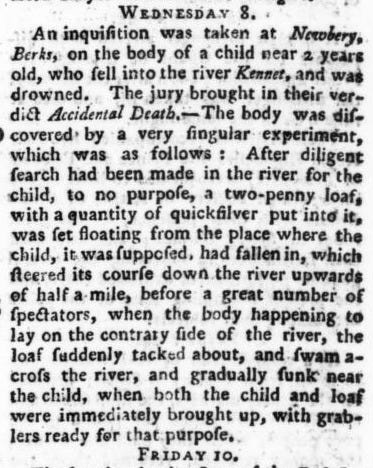
A child had drowned in the River Kennet near Newbury, England. Searchers couldn’t find the body. Someone took a loaf of bread, put quicksilver inside it, and set it on the river. The loaf floated more than half a mile, crossed toward the other bank and sank near the child, right where the body was recovered.
Even old re-tellings of that article have the same amount skepticism for the method that you and I do right now about this story.
The TIME piece wondered whether currents might explain it — whether the same water movement that carried a body into a particular place might also steer a loaf of bread to that spot.
The lake they found her in isn’t really a lake, it’s a reservoir, so there is current moving through it.
A hundred years later, there still isn’t a great reason a loaf of bread would somehow be attracted to a body underwater. Mercury or not. The closest thing to an explanation is probably the water itself. Send anything floating down a river and you’ll find where something might eventually settle.

Either way, a Mrs. George Lewis had drowned. The paper calls her an ardent sportswoman and an angler. She went out fishing by herself. Her boat was found partly filled with water. She was wearing heavy hip boots, and everyone seemed to think that’s what kept her from getting back to the boat, though her friends were insistent that she was a good swimmer.
Sergeant Bushy also had a theory about how it happened. He believed she lost her balance while trying to lower the anchor on the flat-bottomed boat and went over the side. The anchor was still partly lowered when they recovered the boat. The water was about twenty feet deep there, and in high rubber boots, Bushy didn’t think she ever came back up.
When news got back to the neighborhood where the Lewises lived, neighbors were astounded. Several of them recalled that she was a fine swimmer and capable of taking care of herself.
The paper says she was twenty-eight years old. Her funeral was the next afternoon, and she was buried in Mountain Grove Cemetery.
But here’s the thing I noticed all the coverage.
It names her father. It names her brother Louis, who lived in Bridgeport. It names her husband, the medical examiner, the undertaker, the officers who grappled for hours, the funeral home, the church and the cemetery.
But it never once prints her first name.
So I kept looking.
Mountain Grove Cemetery — the cemetery named in the article — has an Irma N. Lewis who died in 1926. Then I found an Irma Curdy quoted in the paper in 1920. Curdy is one of the names the newspaper gives for Mrs. Lewis’s family, alongside another spelling: Kerti.
And the article did name a brother, Louis Kerti, living in Bridgeport. I found a Louis Kerti buried in that same cemetery. He died in 1970, and if him, would have been about thirty when his sister died in 1926.
Then I found one more thing.
Louis had a daughter born that December — about three months after Mrs. Lewis died.
Her name was Irma.
I can’t prove she was named for her aunt. But I really do hope so.
Thanks for listening. Head over to hiddenlenshistory.com to see the original newspaper clippings and images.
Explore your own family history with Ancestry:
*Affiliate disclosure: I may earn a commission if you subscribe or purchase through these links.
See you tomorrow - Chris
Sources
Bridgeport Telegram, Bridgeport, Connecticut, September 14, 1926, pp. 1–2. “Method from ‘Tom Sawyer’ Employed to Recover Body” / “‘Bread Method’ Recovers Body.”
The New York Times, September 15, 1926. “Say Bread Located Body.”
The Daily Messenger, Canandaigua, New York, September 17, 1926. “Finds Drowned Body by Setting Bread Afloat.”
TIME, September 27, 1926. “Science: Bread & Corpse.”
Mark Twain, The Adventures of Tom Sawyer (1876), Chapter XIV.
The Gentleman’s Magazine, Vol. 37, April 1767, p. 189. Account of the River Kennet drowning and the use of a loaf containing quicksilver.
Domestic Encyclopædia (1802), entry on “Drowning,” reprinting and commenting on the 1767 Gentleman’s Magazine account.
Folk-Lore, Vol. 10 (1899), account of an 1898 attempt to locate a drowned woman using bread and quicksilver.
Mountain Grove Cemetery records, Bridgeport, Connecticut. Burial record for Irma N. Lewis.