

I’m looking at a photograph of real babies lined up in a storefront window. And when I first saw the headline that led me to it, I figured there had to be more to the story.
I’m Chris, and this is Hidden Lens History. Every day, I open the newspaper from exactly one hundred years ago, find something worth sharing, and follow the story as far as I can.
It’s September 21st, 1926, and on page 19 of the Evening Star I found this headline:
“BABIES ON EXHIBIT APPEAL TO PUBLIC.”

The Florence Crittenton Home was holding what the newspaper called its “annual fall baby show” in D.C. Apparently ‘baby show’ meant exactly what it sounds like.
Starting at 10 o’clock in the morning, babies from the home were placed in the storefront window where they would be “seen by morning shoppers and people going to and from lunch.” According to the article, the babies looked “healthy and happy,” and the display would continue until 5 o’clock.
Then they’d do it again the next day, and the next, and the next. It went on all week.
It was a fundraiser. The Florence Crittenton Home, which primarily served unmarried pregnant women and young mothers, was asking the public for money to help support the women and babies in its care. Different groups of women would take turns running the exhibit throughout the week. Don’t worry about the babies though. The paper reports:
“Every precaution has been taken, it is pointed out, to make the children happy while they are lending their aid this week by making a visible appeal to the public for aid.”
Which is a pretty direct fundraising strategy. You could put a sign up in the window explaining why you need money. Or, you could just put the babies in the window.
But outside of the title that caught my attention, was how the newspaper called this the annual baby show. Annual?
Of course I had to go looking. Come to find out, this event had a long history. And lucky for us, there’s also a photo.
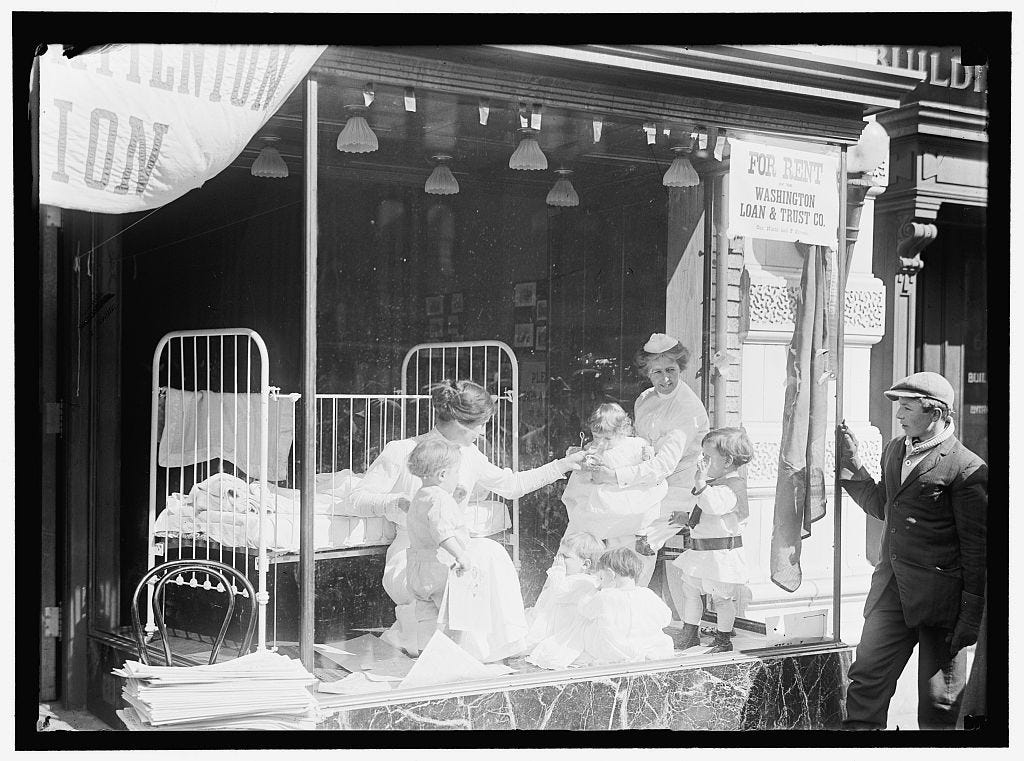
The picture was taken in 1914, and it shows the exact same thing described in 1926. There is one crib and a few babies/toddlers lined up inside the storefront glass. Women are also inside with them. And outside, there’s people on the sidewalk looking through the glass.
So it appears this was not just somebody’s strange idea in 1926: Something that they tried once and never spoke of again. They had been doing this over a decade.
The Florence Crittenton organization went back even further. Charles Crittenton opened the first Florence Night Mission in New York in 1883. He named it after his daughter Florence, who had died the year before at four years old. More Crittenton homes eventually opened up all across the country. This specific Washington home opened in 1896.
By the time of today’s story, the Washington home was primarily serving unmarried pregnant women, and young mothers with babies. And there’s obviously a much bigger history there.
Maternity homes have changed considerably over the decades. And I found some very difficult stories connected to institutions like these, unmarried mothers, and adoption. But that’s a entirely different trail to follow.
For today, I’ll stick with the strange event that week.
It makes me wonder whether this was equally strange to people back then? Imagine you’re reading the paper, or better yet, walking down F street at lunch and just happen upon some babies in a glass window on display. You wonder what in the world is going on here. Then realize you’re outside of the Florence Crittenton Home, and maybe you give them some money.
A brilliant marketing strategy.
And if you missed the babies on September 21st? Don’t worry. They’d be back again tomorrow.
Me too! See you tomorrow - Chris
Sources
Evening Star — September 21, 1926
Library of Congress — Florence Crittenton Home. Baby Exhibit, 1914
VCU Social Welfare History Project — Florence Crittenton Homes
Chevy Chase Historical Society — Florence Crittenton Home history
I just caught sight of this article and I'm going to read it in full, but there is a close Canadian parallel you might find interesting. When you have the time, look up the Dionne Quintuplets. Here is a wikipedia link: https://en.wikipedia.org/wiki/Dionne_quintuplets.