

One hundred years ago today, this appeared in the newspaper.
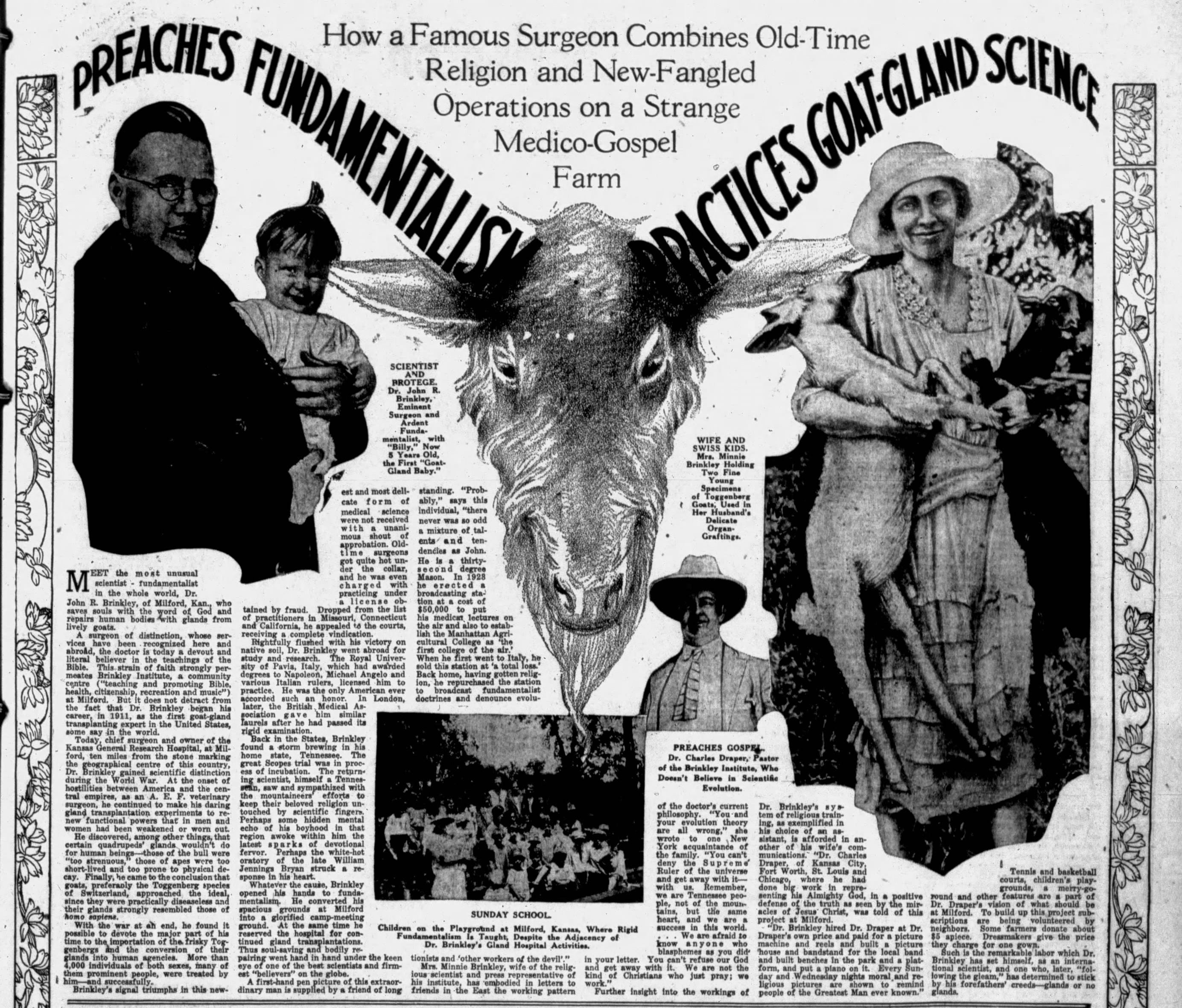
The image is bizarre. An enormous goat staring directly at you. In ribbon bold font on the left “PREACHES FUNDAMENTALISM.” Under that a cutout of a doctor holding a little boy called “the first goat-gland baby.’ On the right, “PRACTICES GOAT-GLAND SCIENCE” and under it the doctor’s wife is holding two goats.
You can probably see why it gained my attention.
The “doctor” is John R. Brinkley, of Milford, Kansas. The article introduces him as:
“the most unusual scientist - fundamentalist in the whole world… who saves souls with the word of God and repairs human bodies with glands from lively goats.”
Basically he became famous performing operations that he claimed could restore youth and sexual vitality by implanting tissue from goat testicles into men. He built an entire hospital around it and became a national celebrity.
But this isn’t the John Brinkley story. He has an entire Wikipedia page. What I wanted to know today is what was it like for someone in 1926 to experience this… and also with a century of hindsight, how it happened.
On its surface, it looks like one newspaper devoting an entire page to a doctor in Kansas, and his redemption story. But it’s way too congratulatory to be journalism. The article outlines how Brinkley had been dropped from the list of practitioners in some states due to claims of license fraud, stating that he then went abroad and obtained his license at: “The Royal University which had awarded degrees to Napoleon, Michael Angelo…”. It went on to explain the irony of the fundamentalism and science cohabitating in Brinkley’s work, his message, and even property which contained a Sunday school run by his wife. At the bottom: Copyright, 1926, International Feature Service.
So this wasn’t just a local reporter stumbling onto Brinkley. It was syndicated, and after searching, I found it running in dozens of newspapers throughout September.
I should have left it at that, but at this point I was too interested to stop.
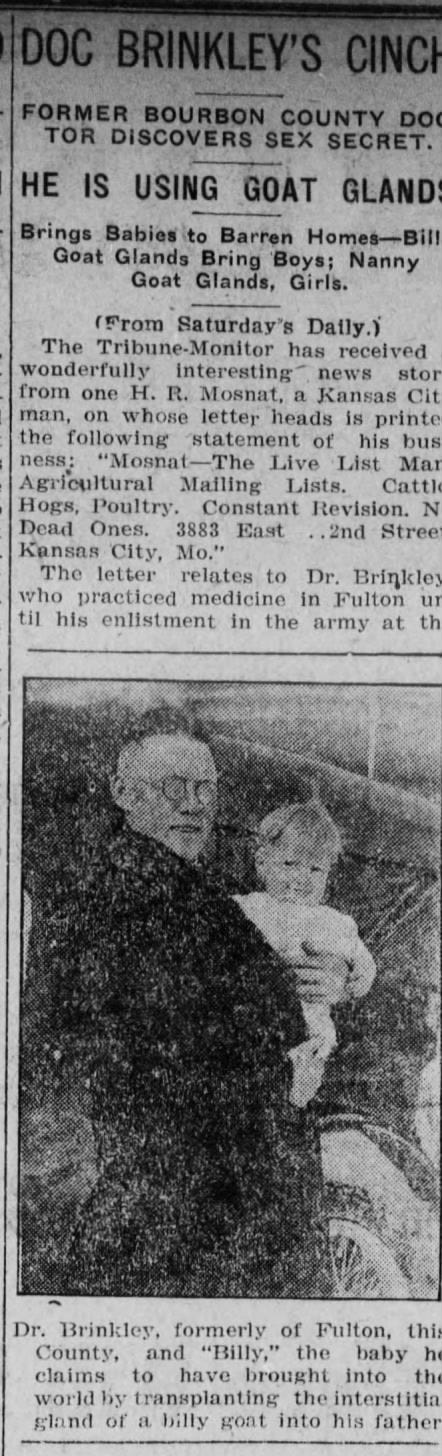
I found one Kansas paper six years earlier running another congratulatory story about Brinkley’s breakthrough work in sexual vitality using goat-glands. This time without the fundamentalism attached. They also spelled it out more clearly. A man named H. R. Mosnat, a mailing-list salesman, had sent editors this promotional material, photograph included.
The photograph was of Brinkley holding a small child. The goat-gland baby. And it stuck out because I’d seen it before. In that full-page spread. Six years later.
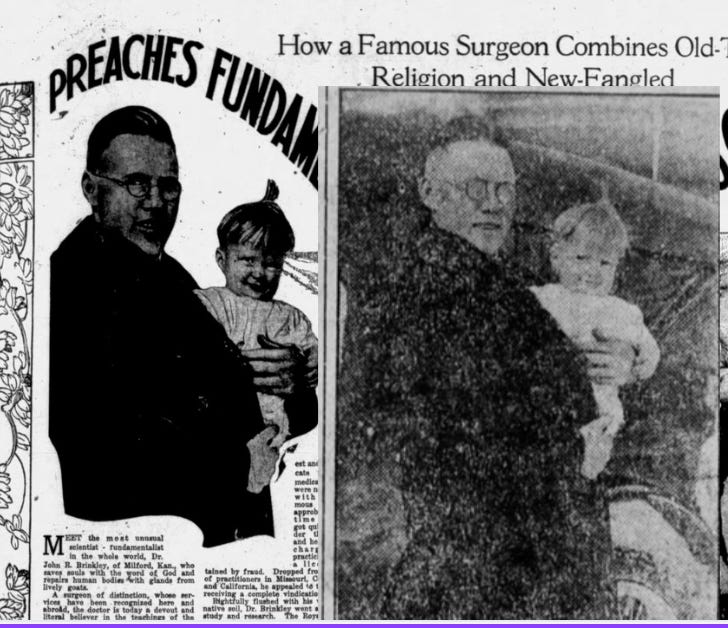
To me, side by side, it sure looks like the same photograph.
Both captions call the boy “Billy” and “Goat-Gland Baby.” The promotional photograph had already been circulating for six years. Later research confirms the same Kansas man, Mosnat was one of the Brinkley’s publicity men in 1926.
None of this was surprising. I’ve seen it before in other stories I’ve done. Men overpromising through aggressive marketing, underdelivering (sometimes dangerously or illegally), and making fortunes along the way.
Except it turns out, Brinkley wasn’t the only one. Apparently, all of America was having a real gland moment.
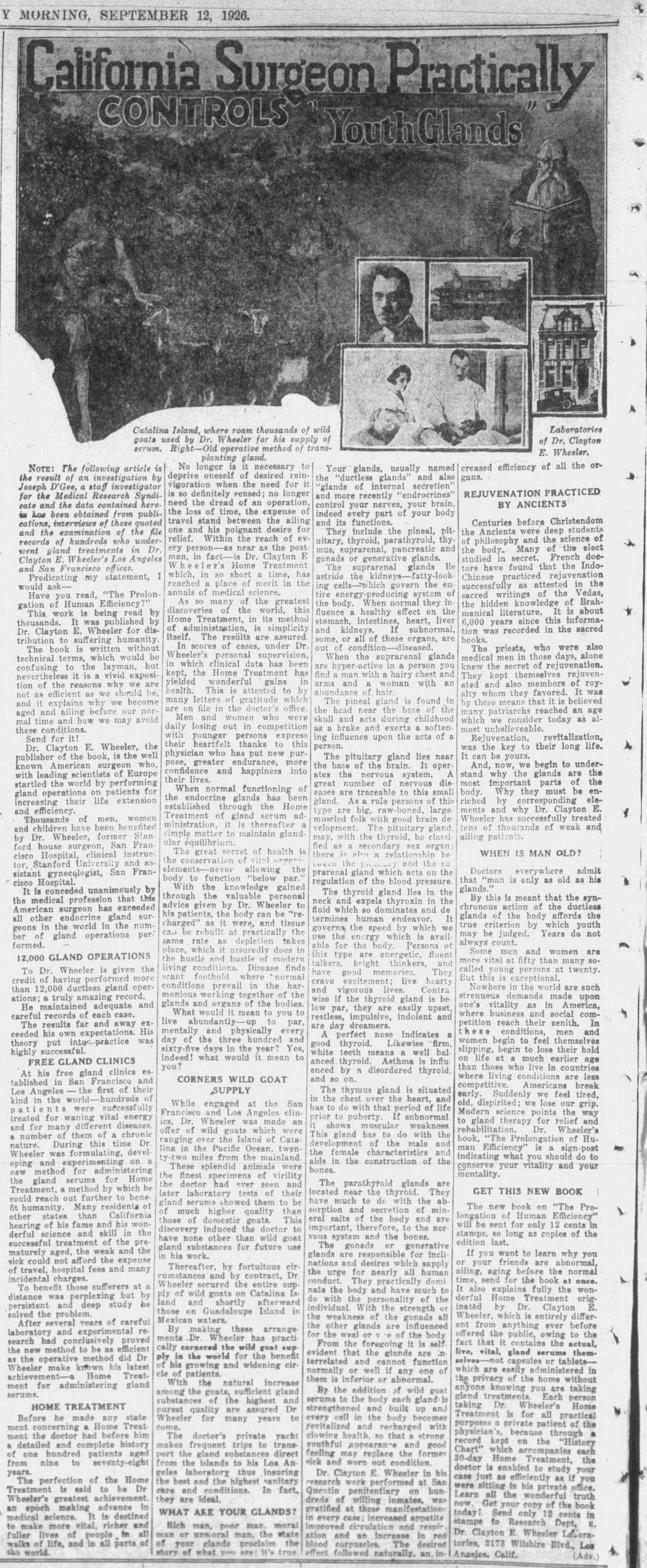
The very next day, September 12th, after the goat spread, a different paper ran this headline: “California Surgeon Practically Controls ‘Youth Glands.’”
This was a different doctor, Clayton E. Wheeler, claiming twelve thousand gland operations, free clinics, and access to wild goats on Catalina and Guadalupe islands. He believed glands from those animals worked better than a domesticated goat’s. The piece claimed he had “practically cornered the wild goat supply in the world.”
I was several columns in before I noticed tiny type at the bottom, “(Adv).” Of course it’s another advertisement. It has headlines, photographs, and all looks remarkably like the journalism running right next to it, but also ends with an invitation to mail Wheeler twelve cents for his book.
For the everyday person in 1926? Probably very confusing. These pages don’t include balanced skepticism . Just the bold advertisements paid by the people selling the treatments. And if you were just flipping through the paper, the sales pitch and the reporting could look remarkably similar.
I went back even further, to 1924. One advertisement says, “GLAND TREATMENT GUARANTEED. GO-GLAND-DO.”
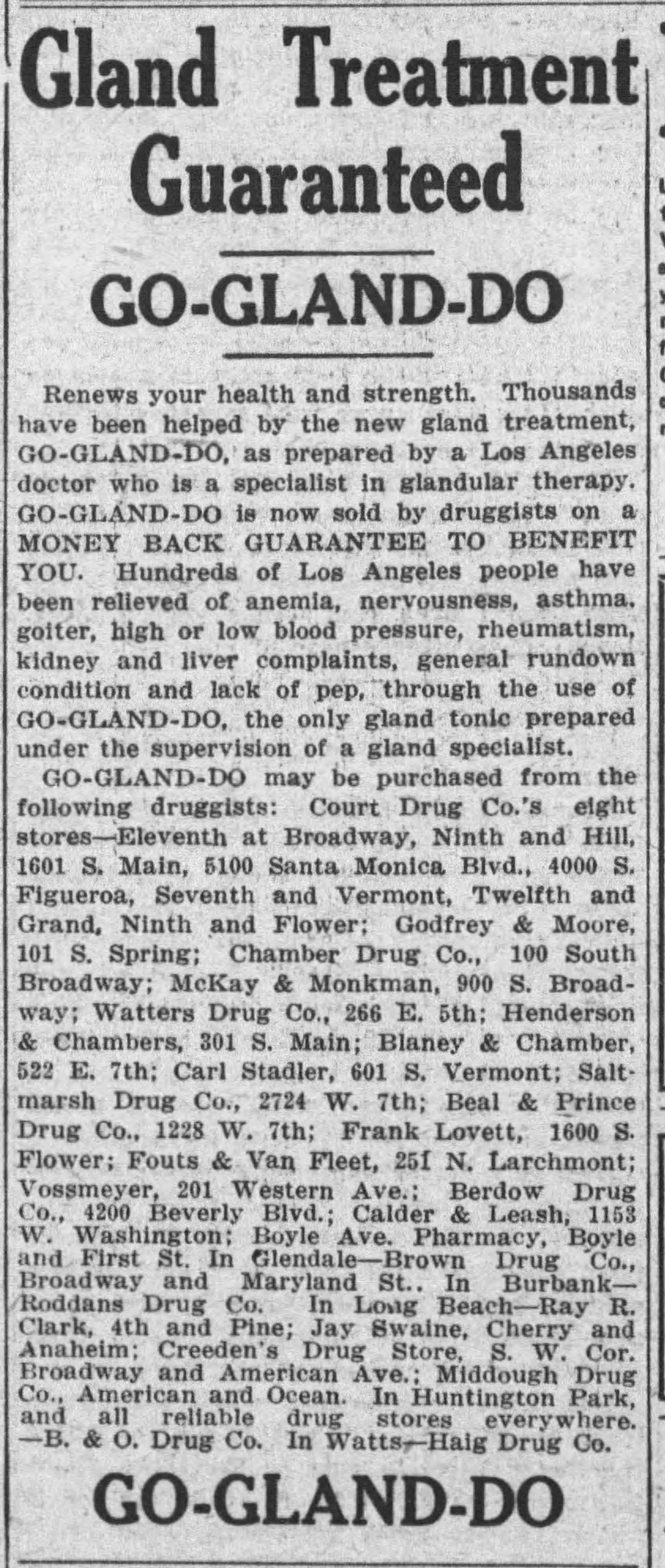
Not surgery this time, but tablets sold at ordinary drugstores across Southern California, promising to restore health, strength, and “pep.”
A Nebraska paper even ran a testimonial from a woman in San Pedro, California, crediting Go-Gland-Do with curing years of sleeplessness. And you don’t have to look to find plenty more.
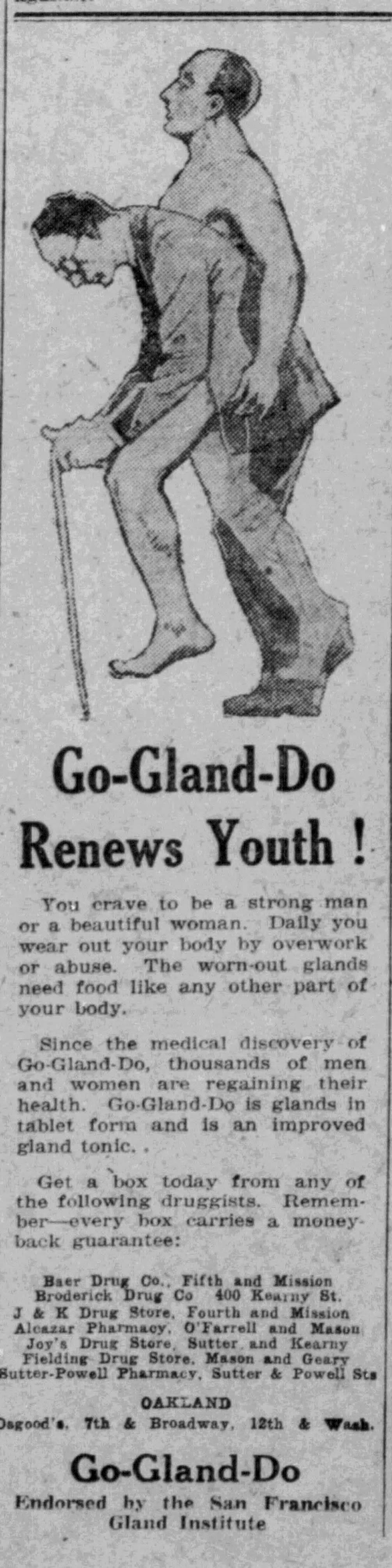
Surgery, clinics, tablets, mail-order books. All different cities, different doctors, different products. All selling some version of the same promise: getting older was something medicine could fix.
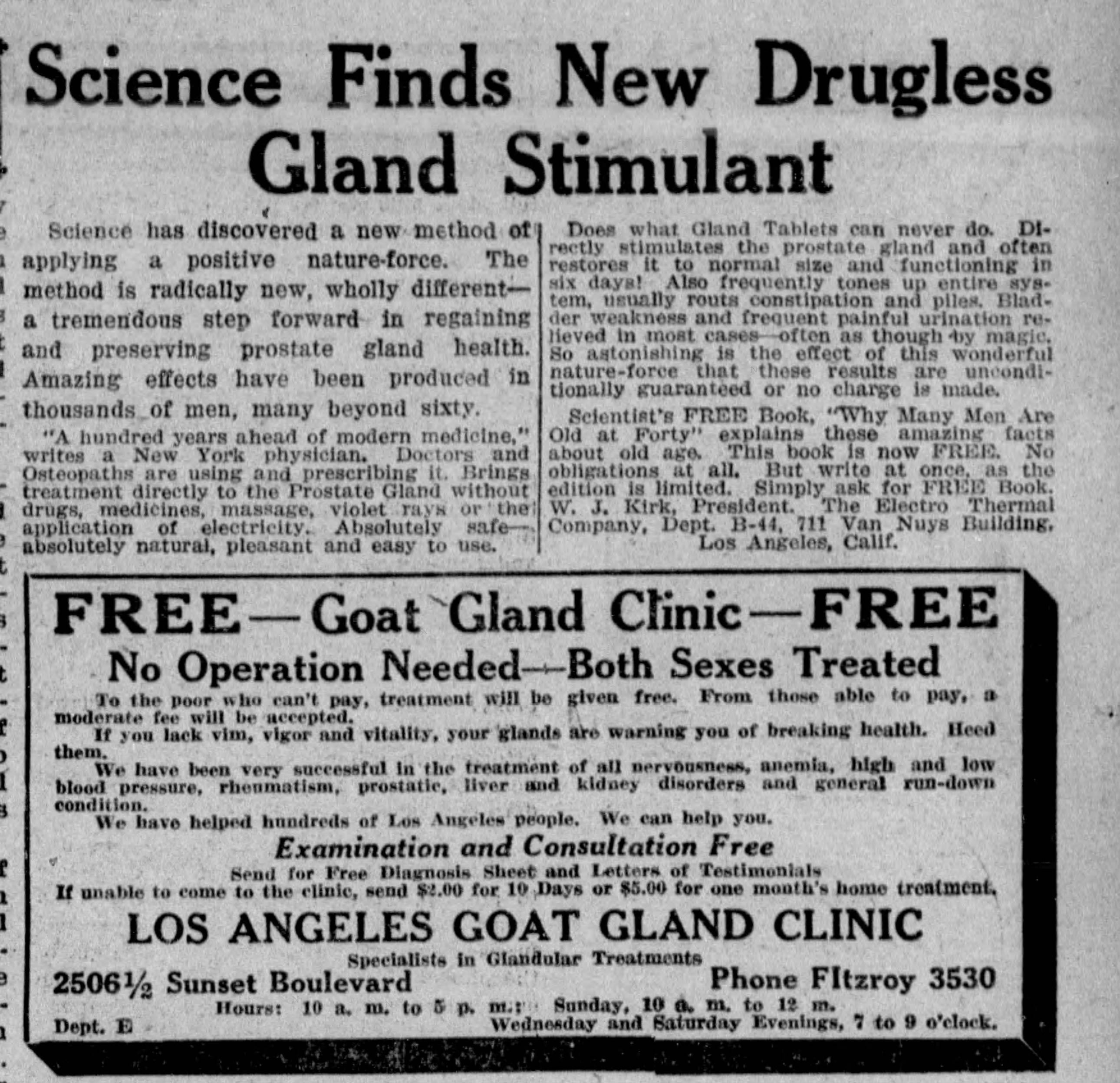
The science underneath all of this was not entirely made up. Researchers really were learning that glands were capable of affecting growth, reproduction, metabolism, and other functions throughout the body. It was also the era when real scientific breakthroughs were happening in hormone research. But plenty of people also saw the new scientific language and realized there was a lot of money in it.
The sales pitch was simple, and effective. Some use it today.
Modern hormone medicine isn’t quite the same thing as sewing goat tissue into somebody, but the words haven’t changed much. Youth, vitality, and rejuvenation. One Wheeler ad promised a patient “20 aging years” lifted from his shoulders. Another was headlined “Almost Like Being Reborn.”
Brinkley’s operation eventually collapsed. Kansas revoked his medical license in 1930, and his reputation and business only deteriorated from there. Wheeler has a less famous, but similar demise.
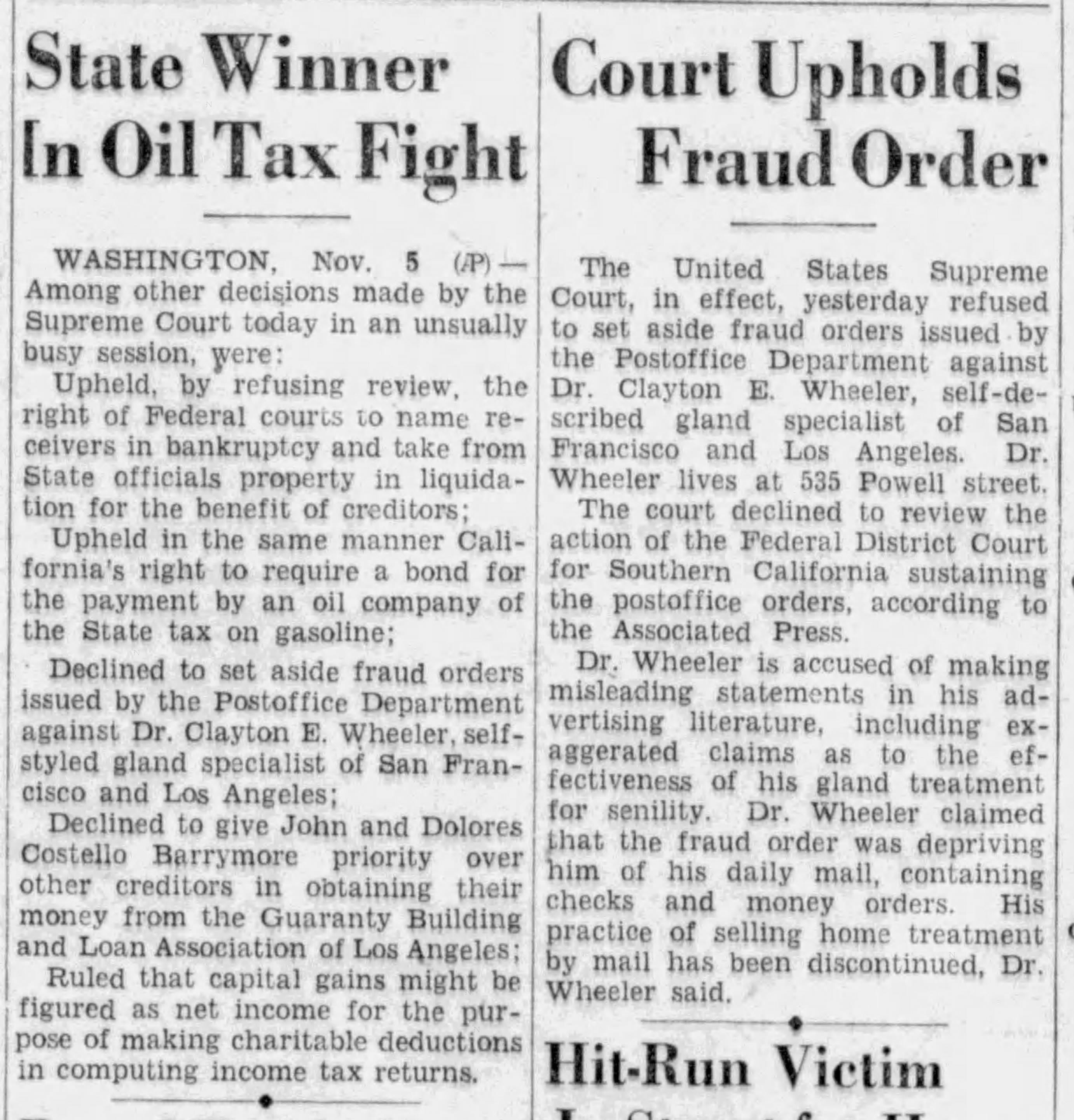
Eight years after that paper said he practically controlled the “youth glands,” Wheeler’s name showed up again under a very different headline:
“Court Upholds Fraud Order.”
The Supreme Court had declined to review a ruling upholding Post Office fraud orders against him over misleading claims in his advertising. Wheeler told the paper he had already stopped selling the treatment by mail.
What sticks with me isn’t really the goat glands. Or the extent any of this was science or not. Instead it was how normal all of this was made to look on the page to intentionally deceive people.
I don’t know about you, but I’m feeling older just having read about all this. Go outside and feel some sunshine today.
See you tomorrow - Chris
Sources
Fort Scott Tribune and The Fort Scott Monitor, January 1, 1920
Hamilton Evening Journal, September 11, 1926 (International Feature Service)
The Salt Lake Tribune, September 12, 1926 (advertisement)
The Los Angeles Times, August 24, 1924
Los Angeles Herald Examiner, September 8, 1924
Lincoln Journal Star, October 16, 1924
The San Francisco Call-Bulletin, December 2, 1925
San Francisco Chronicle, November 6, 1934, “Court Upholds Fraud Order”
Morris Fishbein, The Facts About Rejuvenation (1926)