I stumbled on a headline today that has an actual paper trail spanning years, a First Nations tradition, and a name that's still recognized today.
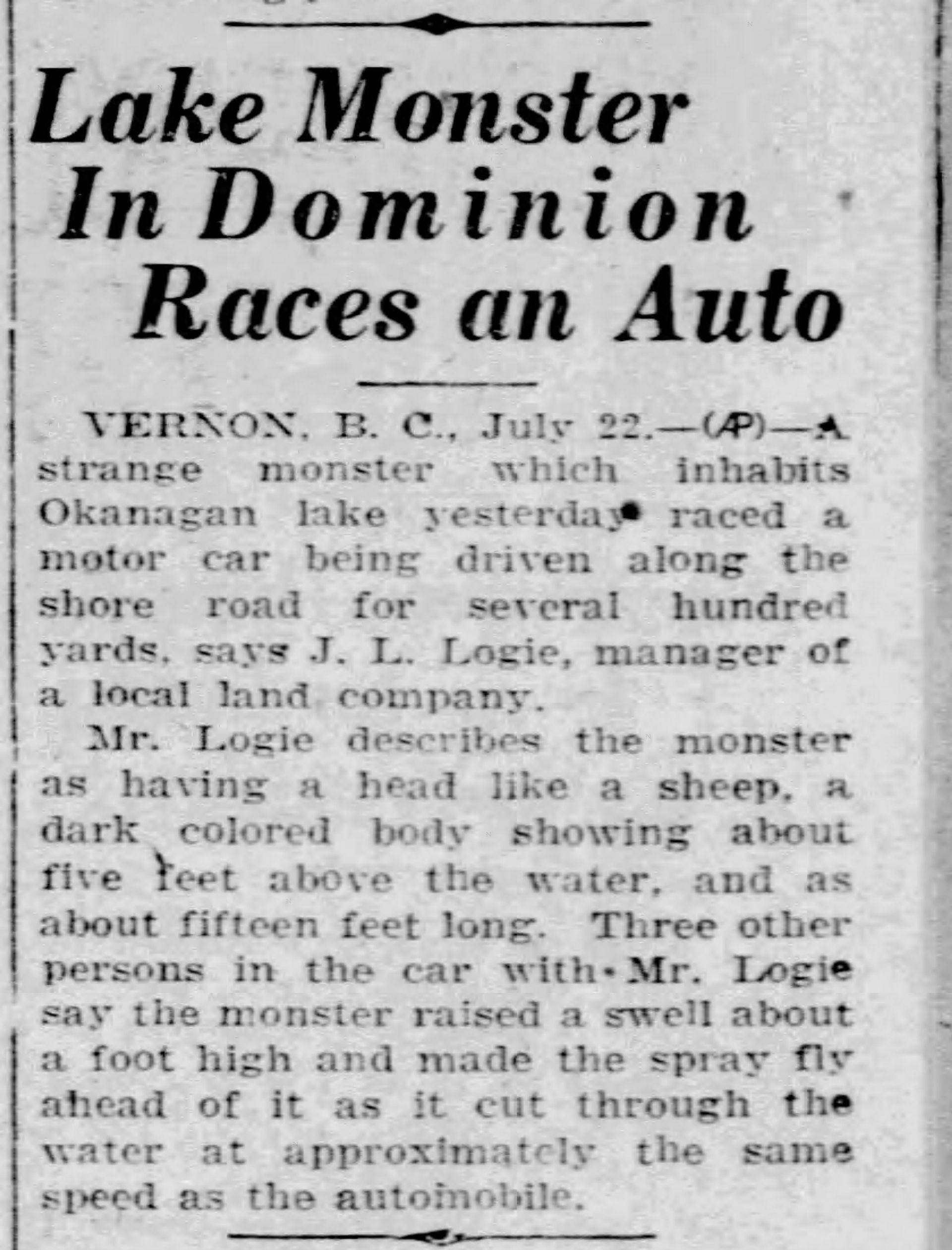
The Monster That Raced a Car
On July 22, 1926, an AP wire story ran in papers all over North America, worded almost identically everywhere it landed. The gist: a strange creature living in Okanagan Lake, British Columbia, had raced a moving car along the shore road for several hundred yards. The account came from J.L. Logie, a local land company manager, and three passengers backed him up.

The description was consistent across every paper that ran it: a head like a sheep, a dark colored body showing about five feet above the water, and a length of roughly fifteen feet, cutting a swell a foot high as it kept pace with the automobile.
An Old Friend, Right on Schedule

Two days later, an editorial treated the whole thing with open amusement, framing the sighting as a familiar seasonal ritual rather than news. The writer suggested the naturalist William Beebe, fresh off diving expeditions near the Galapagos, ought to grab his helmet and go find out what was really down there.
The Lake Itself
Okanagan Lake had been a working waterway for decades by 1926, long, narrow, and glacially carved, with steamboats and rail barges already running its length. It's genuinely deeper than Loch Ness.

Sicamous sternwheeler on Okanagan Lake, 1920s — file: Sicamous__sternwheeler__on_Okanagan_Lake_1920s.jpg — public domain
Where'd He Go?

A year later, a different paper openly wondered where their "old friend" had disappeared to, noting the timing was suspicious, no sightings during peak tourist season, and pointing out a $500 reward was sitting unclaimed for anyone who could produce a photograph.
The following year, a travel book by Marjorie Harrison added a new detail to the legend: a skeptical steamboat captain who told her he'd spent thirty years running that lake at every hour of day and night and had never seen a thing.
What This Actually Is
Here's the part that turns a fun 1926 wire gag into something with real weight. The creature the papers were treating as a novelty had a name and a relationship with the region's people long before any of these reporters showed up. The Syilx people call it N'ha-a-itk, a water spirit that commanded respect, with travelers traditionally leaving small offerings when crossing the lake near a spot called Squally Point. That's the same stretch of water where modern sightings still concentrate today, a thread running from oral tradition straight through a century of newspaper coverage. The name "Ogopogo" that stuck, the one on Wikipedia now, actually comes from a 1920s British music hall song, and many Syilx people consider it a trivialization of what was originally sacred.

Okanagan Lake Indian fishermen 1908: Babcock, John Pease (1908) Game Fishes of British Columbia, Victoria: Richard Wolfenden
Still Looking, Decades Later
By 1990, the search had gone from wire-story novelty to something people were actively investigating with equipment. A Japanese television crew filming a documentary on the legend picked up a sonar reading 320 feet down, an object 30 to 40 feet long, producing a wavy line rather than the straight signal a log would leave. The boat owner who spotted it noted the disturbance around it looked like propeller bubbles, not driftwood. A longtime local Ogopogo researcher aboard for the same trip called it obviously alive.

By 2001, that same researcher, a Kelowna writer who'd been collecting sightings and stories since the late 1960s, released a full book on the subject, citing a boat's sonar picking up something 40 feet long the year before. Her stance was carefully drawn: not a monster, an unknown animal, and one more reason to think about what human activity might be doing to whatever's actually living in that lake.

The tourism industry, meanwhile, had fully embraced it. A year earlier, local promoters had rolled out a Two Million Dollar Search for Ogopogo contest, complete with a cartoon golfing mascot and a vacation-package giveaway, evidence to be judged by a university biology department and a panel of cryptozoologists.

And the creature has a permanent home now. There's a statue of it in a Kelowna park, sea-serpent coils looping out of a painted blue pool, the closest thing this legend has to an official portrait.

A hundred years since that first wire story, and nobody's collected on any reward. Nobody's stopped looking either.
See you tomorrow. – Chris
Sources
Newspapers:
Casper Star Tribune, July 22, 1926
Lancaster Daily Intelligencer, July 22, 1926
Evening Star, July 24, 1926
The News Tribune, July 21, 1927
Vernon News, July 5, 1928
Standard-Freeholder, July 25, 1990
The Morning Star, August 6, 2000
The Morning Star, July 13, 2001
Photos:
Sicamous sternwheeler on Okanagan Lake, 1920s — Wikimedia Commons, public domain
Statue of Ogopogo in a Kelowna park — photo by Hamedog, English Wikipedia, cropped by Beyond My Ken
Railway and steamboatmen at Okanagan Landing, October 1892 — photo by Alfred D. Worgan, Provincial Archives of British Columbia B-07281, public domain
